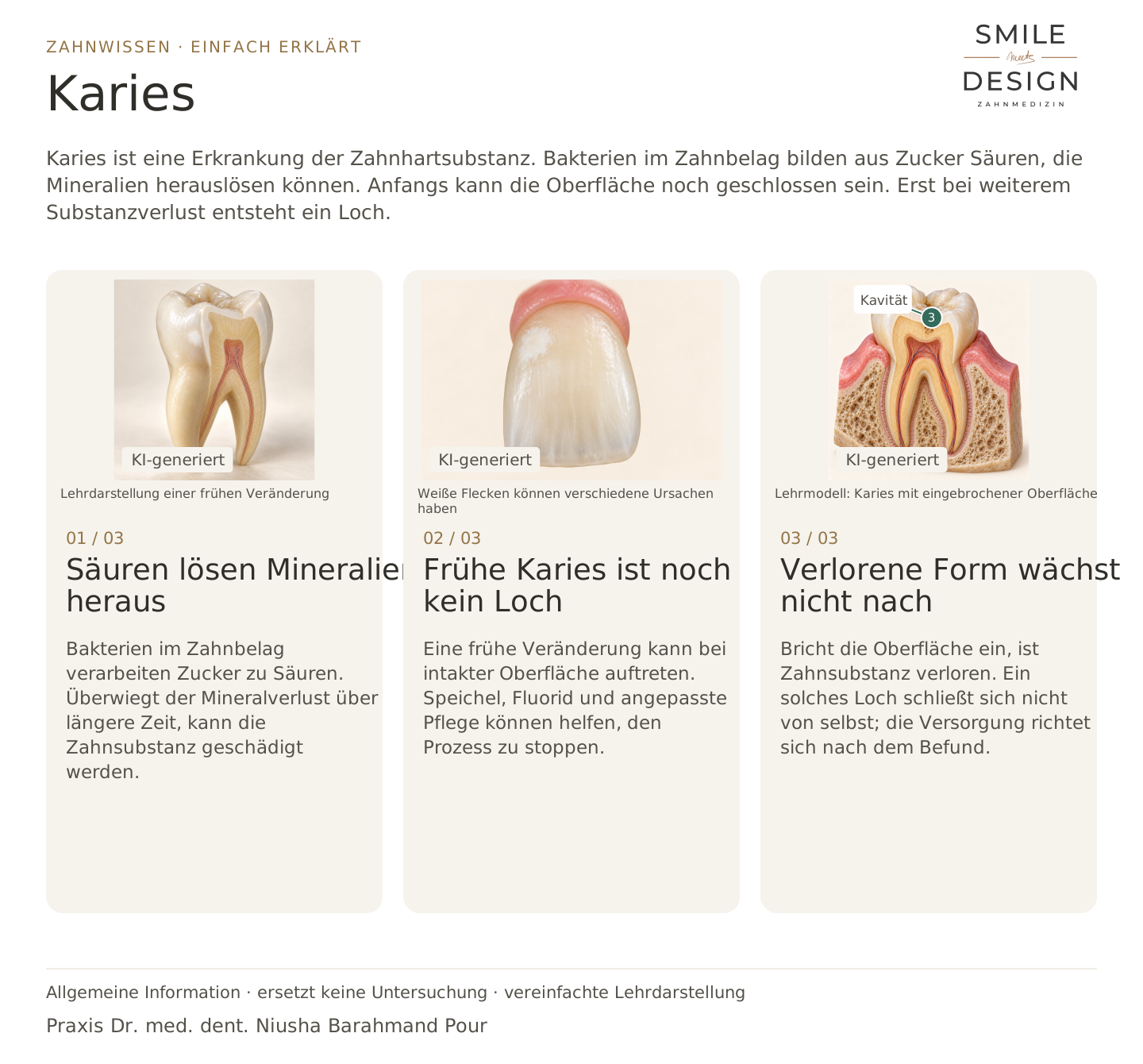
What attacks the tooth tissue?
Bacteria in biofilm turn sugar into acids. If more minerals are lost than replaced over time, tooth tissue can be damaged.

Tooth decay is a disease of the hard tooth tissues. Bacteria in plaque turn sugar into acids that can dissolve minerals. At first, the surface may remain intact. A cavity forms only when further tooth tissue is lost.
For dental trainees & teams
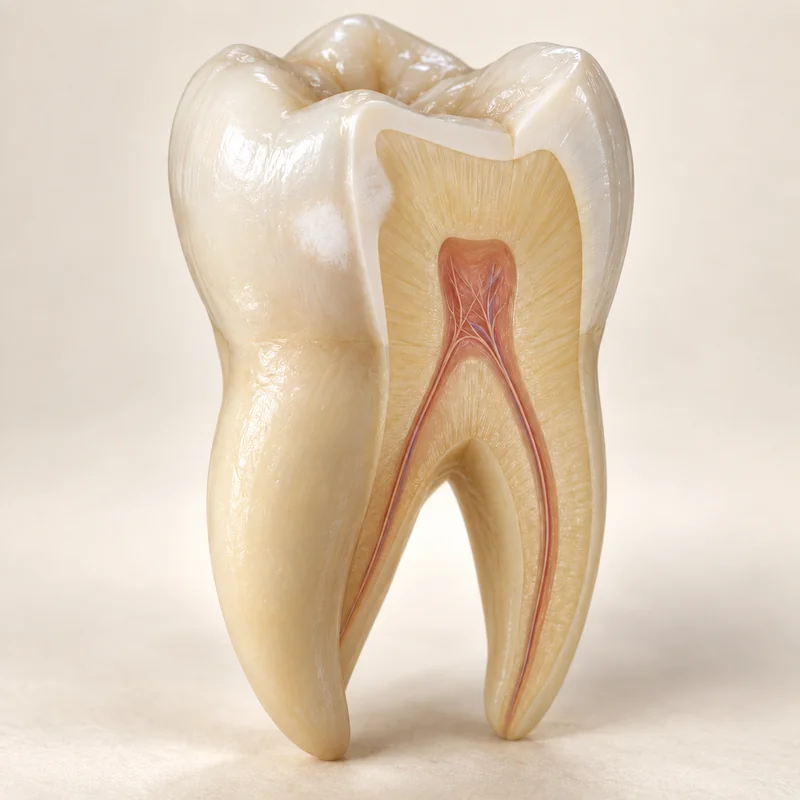
Bacteria in dental plaque convert sugar into acids. If mineral loss outweighs replacement over time, the tooth tissue can be damaged.
An early change can occur beneath an intact surface. Saliva, fluoride and suitable care can help stop the process.
When the surface breaks down, tooth tissue has been lost. The resulting cavity does not close by itself; treatment depends on the findings.
Bacteria in biofilm turn sugar into acids. If more minerals are lost than replaced over time, tooth tissue can be damaged.
Early changes may lie beneath a still-intact surface. A white spot alone, however, does not prove there is decay.
In early changes, fluoride, saliva and suitable care can help stop the process. They do not rebuild tooth shape that has already been lost.
Three steps. Straight to the point.
Explanations are also shown on screen.

Silent film in German · English explanations in the three views above
In tooth decay, bacteria produce the acids. Erosion is caused by acids from other sources, such as food or stomach contents. Both can damage tooth tissue.
No. White areas can have different causes. Colour or a photograph alone is not enough for a reliable assessment.
Repeated sugar intake enables repeated acid production in the biofilm. This leaves less time for the mineral balance to recover.
Fluoride supports mineralisation in early changes. Toothpaste cannot rebuild tooth shape that has already been lost.
A question to discuss with Dr. med. dent. Niusha Barahmand Pour:
Is the tooth surface still intact, and which treatment can preserve as much of the existing tooth tissue as possible?
Preserving teeth and a functioning bite are central to her practice profile, alongside aesthetic treatment.
An examination helps assess unusual areas on teeth and discuss the next steps.
Have your teeth examinedChoose an appointment on DoctolibBuild on the simple explanation with clinical terms, key distinctions and a knowledge question.
An early decay lesion can still have an intact surface. Remineralisation is not the same as closing an existing cavity.
Editorial research: 22 October 2026. This explanation covers general principles and does not replace a personal examination. Suitable treatment is discussed following individual assessment.