Contents?
Usually a collection of saliva.

A ranula is a saliva-filled swelling in the floor of the mouth, often related to the sublingual salivary gland. It may appear bluish and cause little pain. Other conditions can look similar, so a new swelling beneath the tongue needs examination.
For training & practice ↓
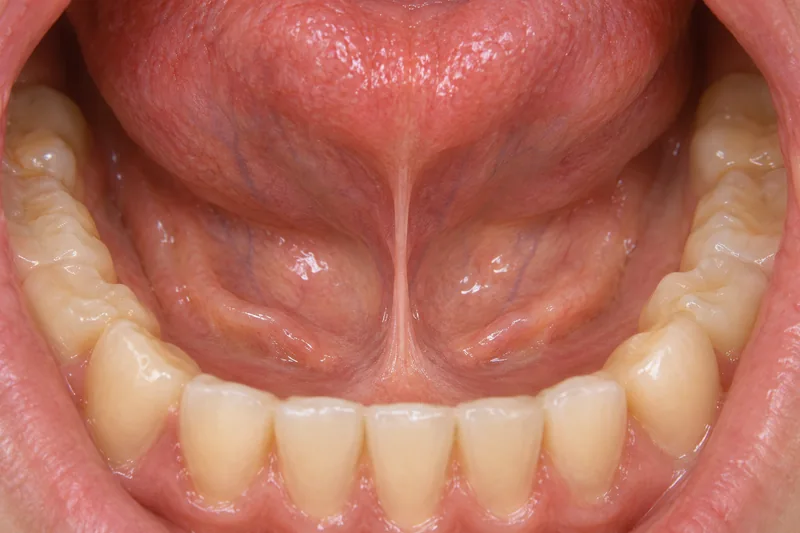
Escaped saliva can collect in tissue. A ranula is not the same as a salivary stone.
Some swellings remain in the mouth floor; others extend deeper into the neck. Examination and, where needed, imaging clarify the extent.
Observation or a procedure may be considered depending on findings. Recurrent changes also prompt consideration of the involved gland.
Usually a collection of saliva.
Not reliable.
Call 112 immediately.
Three steps. No audio.
Each scene can also be selected manually.

Silent educational film with German on-screen text and simplified teaching images. Not a patient case or a promised treatment outcome. The full English explanation is available as text.
Both terms concern saliva collections. Ranula particularly describes the mouth-floor lesion; a swelling on the lip is different.
No. Do not puncture, squeeze or apply heat. This does not establish the cause and can cause injury.
A recurrent or unexplained swelling still needs assessment. Size and pain alone do not establish its cause.
Call 112 for breathing difficulty or rapidly increasing swelling with swallowing problems. Significant new swallowing difficulty or rapid growth also needs same-day medical assessment even without breathlessness.
Editorially suggested question to discuss with Dr Niusha Barahmand Pour:
Where is the swelling coming from, and is specialist assessment needed?
Have new swelling under the tongue assessed. For breathlessness or rapid swelling with swallowing difficulty, call 112 immediately rather than waiting for online booking.
Call the practice · 0221 669 401 80Telephone contactBoth terms concern saliva collections. Ranula particularly describes the mouth-floor lesion; a swelling on the lip is different.
Editorial research: . General information, not an individual diagnosis or treatment recommendation. Teaching illustrations are simplified and do not depict a patient case.