Who may find this relevant?
People with recurring swelling below the tongue or jaw or in the cheek, particularly around meals.

A salivary stone is a solid deposit within a salivary gland or its duct. If it impedes drainage, saliva can back up. Pain or recurring swelling during meals may fit this pattern, but other causes are possible.
For training & practice ↓
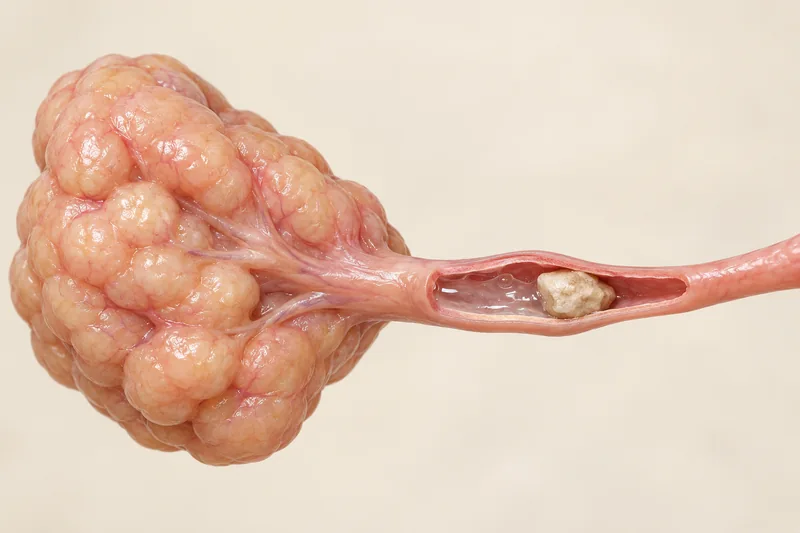
Salivary glands release fluid into the mouth through narrow ducts. A stone may partly or completely obstruct that route; the area beneath the tongue is commonly involved.
Eating stimulates saliva production. With an obstructed duct, the backup may become particularly noticeable. The timing is useful information for an examination, not a self-test.
An examination and, when indicated, imaging such as ultrasound can clarify the location. Management depends on position, size and inflammation. Fever or worsening symptoms require prompt assessment.
People with recurring swelling below the tongue or jaw or in the cheek, particularly around meals.
Through examination and selected imaging, with ENT or another specialist when appropriate.
Promptly for fever or worsening pain or swelling; immediately for breathing or swallowing difficulty.
Three steps. No audio.
Each scene can also be selected manually.

Silent educational film with German on-screen text and simplified teaching images. Not a patient case or a promised treatment outcome. The full English explanation is available below.
Salivary glands release fluid into the mouth through narrow ducts. A stone may partly or completely obstruct that route; the area beneath the tongue is commonly involved.
Eating stimulates saliva production. With an obstructed duct, the backup may become particularly noticeable. The timing is useful information for an examination, not a self-test.
An examination and, when indicated, imaging such as ultrasound can clarify the location. Management depends on position, size and inflammation. Fever or worsening symptoms require prompt assessment.
A stone is an obstruction. Inflammation affects gland tissue. They can occur together, but neither necessarily proves the other.
No. Calculus adheres to tooth surfaces. A salivary stone is within a duct or gland and may block saliva drainage.
Do not use sharp objects or force. This can injure the tissue or duct. Whether and how a stone needs removal should be assessed professionally.
No. Other changes can affect a duct or gland. Recurring or persistent swelling deserves medical or dental assessment.
An editorially suggested question for a discussion with Dr med dent Niusha Barahmand Pour:
Could a salivary duct be involved, and would an ENT assessment be appropriate?
Recurring swelling during meals should be assessed. An initial examination can help identify the appropriate next service.
Discuss the symptomsAppointment selection at DoctolibA stone is an obstruction. Inflammation affects gland tissue. They can occur together, but neither necessarily proves the other.
Editorial research: . General information, not an individual diagnosis or treatment recommendation. Teaching illustrations are simplified and do not depict a patient case.