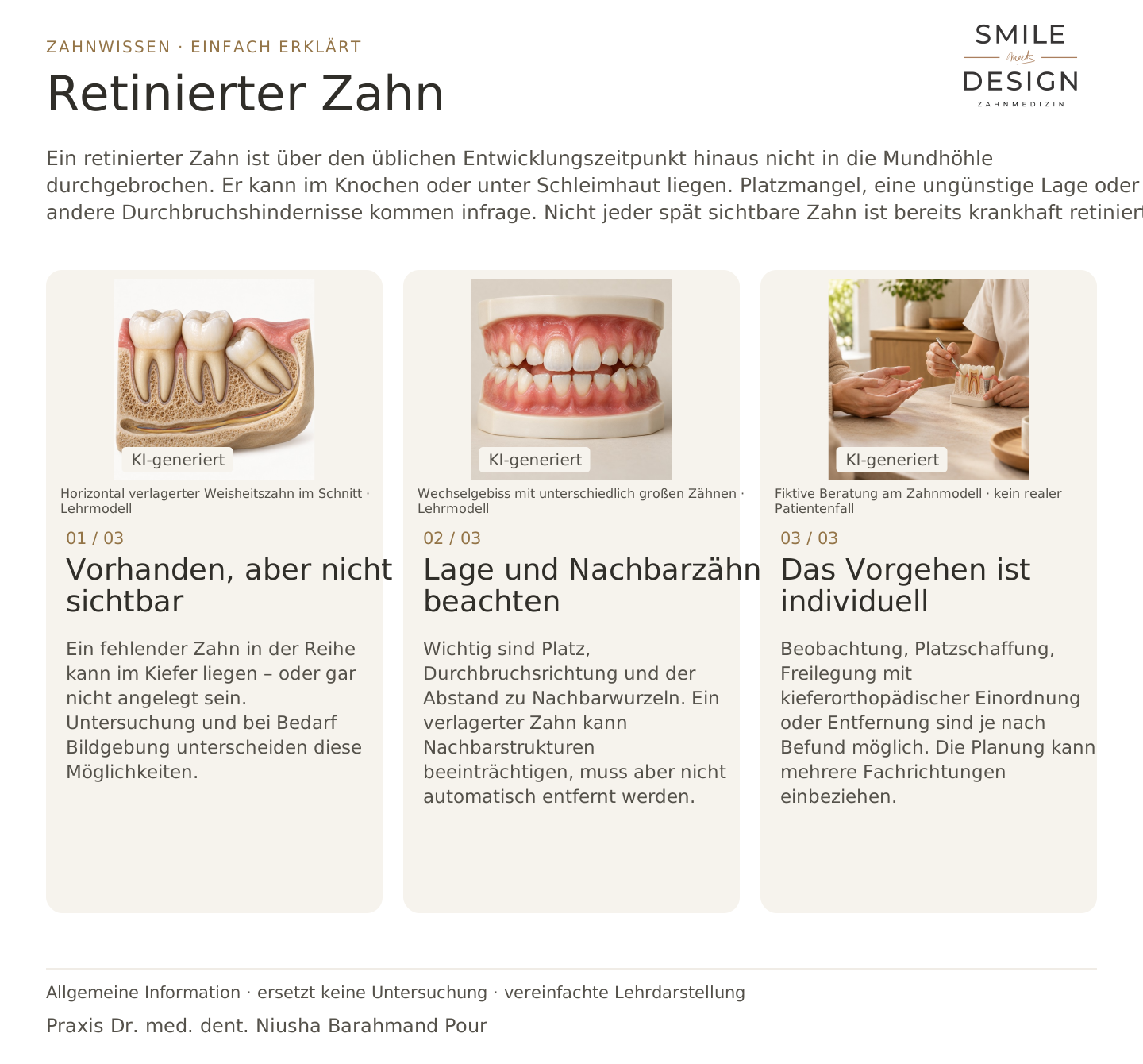
What does unerupted mean?
A present tooth has not emerged in the expected developmental course.

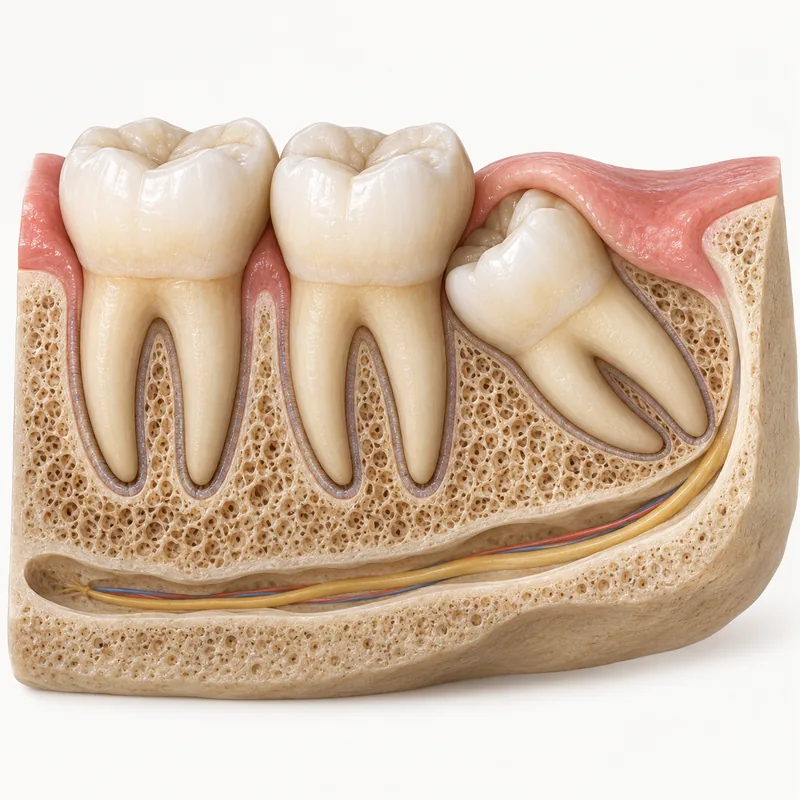
An unerupted tooth may remain in bone or beneath the gum beyond the expected developmental stage. Lack of space, an unusual position or another obstruction can be involved. Not every tooth that appears late is pathologically impacted.
For dental trainees & teams
A gap may hide a tooth still inside the jaw, or a tooth may never have formed. Examination and imaging when needed distinguish the possibilities.
Space, eruption direction and proximity to neighbouring roots matter. A displaced tooth can affect adjacent structures, but does not automatically need removal.
Monitoring, space creation, surgical exposure with orthodontic alignment or removal may be options. Planning can involve more than one dental specialty.
A present tooth has not emerged in the expected developmental course.
By developmental comparison, examination and targeted imaging where needed.
This depends on tooth type, position, risks and options for retaining it.
Three steps. Straight to the point.
Explanations are also shown on screen.

Silent film in German · English explanations in the three views above
An unerupted tooth is present but has not emerged. With hypodontia, one or more teeth never formed. Looking at the gap alone cannot distinguish them.
No. Other teeth, such as upper canines, may also fail to erupt normally. The implications and treatment depend on tooth type and position.
Not in every case. Symptoms, disease, neighbouring teeth, age and the prospects for alignment are weighed together.
If eruption differs markedly from the other side, a baby tooth stays unusually long or symptoms arise. Normal developmental variation is taken into account.
A question to discuss with Dr. med. dent. Niusha Barahmand Pour:
Has the missing tooth formed, where is it positioned, and would orthodontic or surgical assessment help?
Symptoms, examination findings and personal wishes form the basis of individual treatment planning.
An unusual eruption pattern can be assessed early.
Have tooth eruption assessedChoose an appointment on DoctolibBuild on the simple explanation with clinical terms, key distinctions and a knowledge question.
Failure to erupt and an ectopic position describe different aspects. A tooth can show both; the term alone does not dictate treatment.
Editorial research: 23 October 2026. This explanation covers general principles and does not replace a personal examination. Suitable treatment is discussed following individual assessment.