What does it show?
An overview of teeth and large parts of both jaws.

An orthopantomogram, or OPG, is a two-dimensional panoramic X-ray. It provides an overview of the teeth and large parts of both jaws. It may help answer questions about eruption or tooth positions. It is taken only when justified by the specific diagnostic question.
For dental trainees & teams
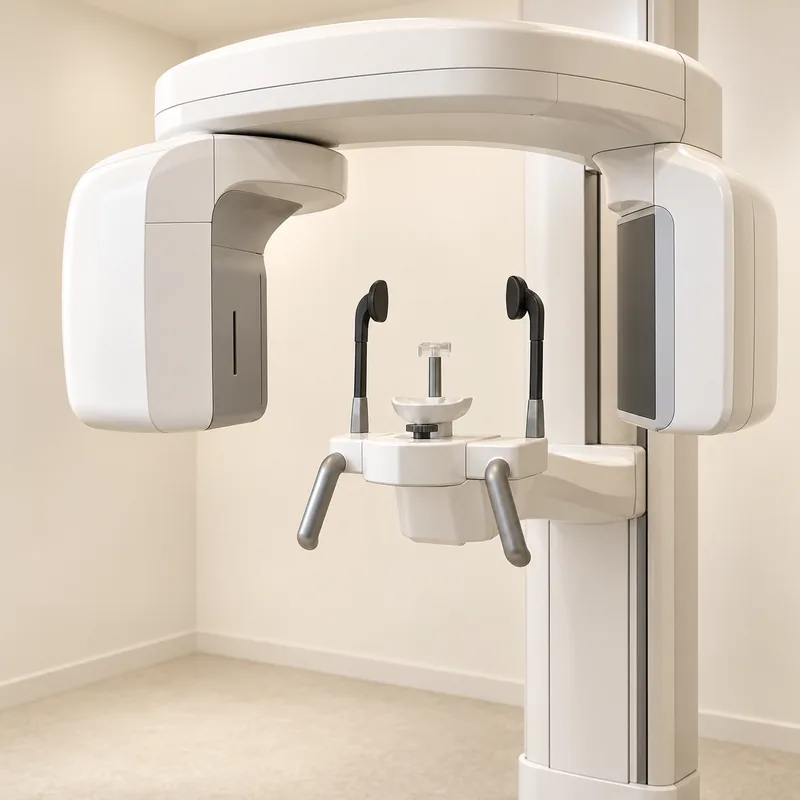
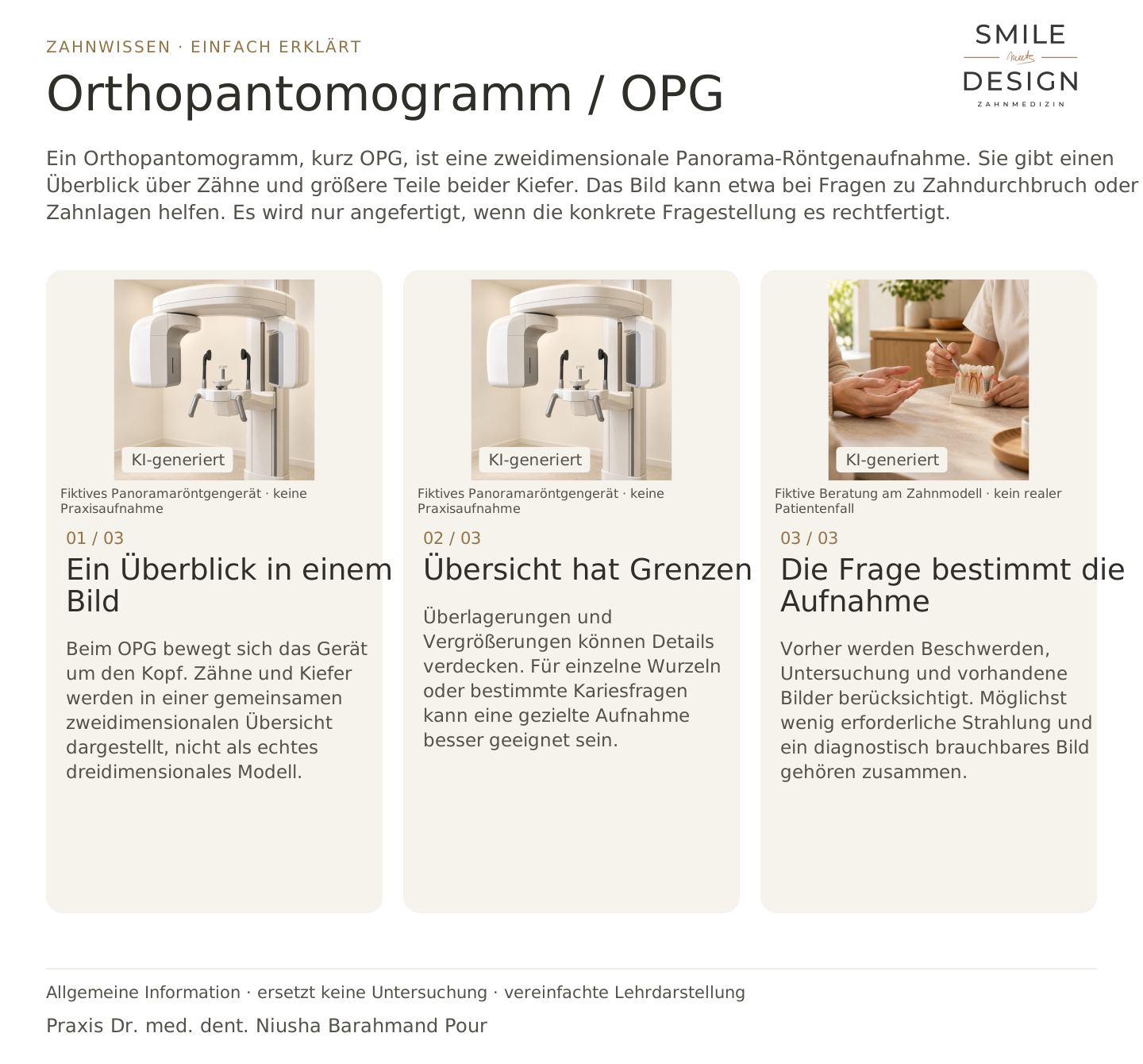
During an OPG, the machine moves around the head. Teeth and jaws appear in a shared two-dimensional overview, not a true three-dimensional model.
Overlapping structures and magnification can hide detail. A targeted image may be better suited to individual roots or particular decay questions.
Symptoms, examination findings and existing images are considered first. The aim is diagnostically useful imaging with the lowest necessary radiation exposure.
An overview of teeth and large parts of both jaws.
People with a suitable specific diagnostic question.
History, examination and consideration of existing images.
Three steps. Straight to the point.
Explanations are also shown on screen.

Silent film in German · English explanations in the three views above
An OPG gives a two-dimensional overview. CBCT provides three-dimensional sectional data for selected questions. More dimensions do not automatically mean greater benefit.
No. X-rays are not taken simply by a fixed calendar. Examination and a specific diagnostic question determine whether an image is needed and which type.
No. Some areas overlap and small changes may not be visible. Clinical examination or a more targeted X-ray can help with particular questions.
No. Digital X-rays also use ionising radiation. The technique and settings are adapted to the examination; existing images can prevent unnecessary repeats.
A question to discuss with Dr. med. dent. Niusha Barahmand Pour:
Which specific question would this image answer, and might existing images already be sufficient?
Symptoms, examination findings and personal wishes form the basis of individual treatment planning.
Existing X-rays can be helpful when discussing examination findings.
Discuss findings and imagingChoose an appointment on DoctolibBuild on the simple explanation with clinical terms, key distinctions and a knowledge question.
Panoramic geometry produces position-dependent magnification and distortion. Sizes and distances cannot therefore be measured as directly as on a physical model.
Editorial research: 23 October 2026. This explanation covers general principles and does not replace a personal examination. Suitable treatment is discussed following individual assessment.