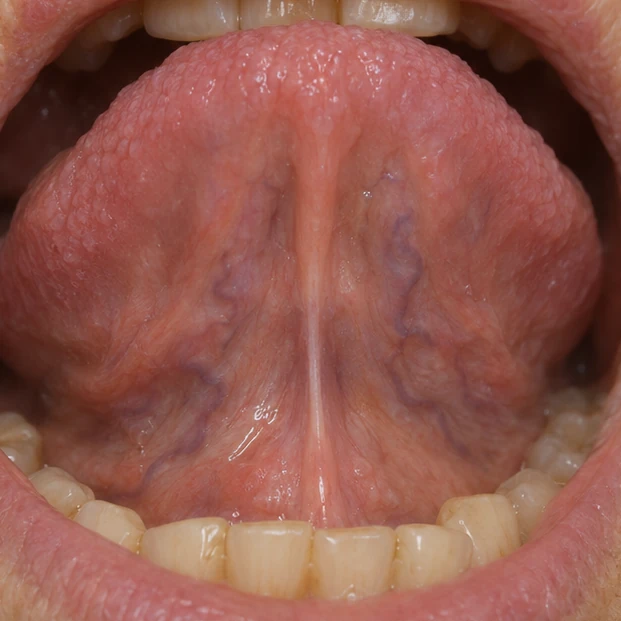
Thin blue veins are often visible on either side when you lift your tongue. As they widen and become more winding with age, they are called sublingual or lingual varices. They can look like a series of small blue-purple beads and usually cause no symptoms. Floor of the mouth
Typical, asymptomatic sublingual varices that have been identified by a clinician usually need no treatment. In a Swedish follow-up study, most adults remained in the same severity category eight years after their first examination.
02
Do visible veins mean that I have high blood pressure?
The appearance of the underside of the tongue cannot tell you your blood pressure. Observational studies have investigated possible associations. A blood pressure measurement answers the clinical question.
03
When should I show a blue spot to someone?
A spot that is new, growing on one side, becoming hard or bleeding repeatedly deserves dental or ENT assessment.
Knowledge in motion
Explained in 36 seconds.
Three steps. No audio. Each scene can also be selected manually.
Silent film with English on-screen text and simplified teaching images.
Lifting the tongue tip reveals the midline frenulum. The larger veins lie to either side.
Quick answersDo they require treatment?
Typical, asymptomatic sublingual varices that have been identified by a clinician usually need no treatment. In a Swedish follow-up study, most adults remained in the same severity category eight years after their first examination.
Do visible veins mean that I have high blood pressure?
The appearance of the underside of the tongue cannot tell you your blood pressure. Observational studies have investigated possible associations. A blood pressure measurement answers the clinical question.
When should I show a blue spot to someone?
A spot that is new, growing on one side, becoming hard or bleeding repeatedly deserves dental or ENT assessment. If you are unsure about a stable finding, you can also show it at your next dental visit. A single dilated vessel on the lip may look different. Venous lake of the lip
At the practice
At the examination
A question to ask
Does this distribution follow the usual course of the veins beneath the tongue?
A growing, firm or repeatedly bleeding area deserves dental or ENT assessment.
Learning layer for training & practiceUnderstand terminology and deepen knowledge
Sublingual
Situated beneath the tongue.
Varix
A localised dilatation of a vein.
Make the distinction
Record the distribution and the history. Multiple bluish dilatations along the veins on the underside of the tongue are typical. A solitary new pigmented nodule requires its own assessment.
Editorial research: . General information, not an individual diagnosis or treatment recommendation. Teaching illustrations are simplified and do not depict a patient case.
If you turn this on, this website stores which guides you open, separately from advertising preferences. The markers expire after a fixed 30-day period from activation. The list is not sent to us by this feature. You can turn it off here and delete the markers.
Other people using the same browser profile can also see the markers. German and English versions share one marker. Expired entries are removed the next time you open a page with this feature; deleting browser data may remove them earlier. “Viewed” means opened, not read or completed.
With your consent, we use Google Ads to attribute clicks on our appointment booking links and phone number to adverts. Google processes technical usage data and sets or reads cookies. Data may be processed in the USA. Advertising measurement does not load without your consent. Google Analytics and personalised advertising are not enabled. Google Maps loads separately when you choose to open the map. You can change your choice here at any time.