Can it go unnoticed?
Yes, it may be found without causing symptoms.

A torus palatinus is a benign bony prominence in the middle of the hard palate. It is covered by oral lining and often causes no symptoms. An examination establishes whether a lump is actually a torus. Not every lump in the mouth has the same cause.
For training & practice ↓
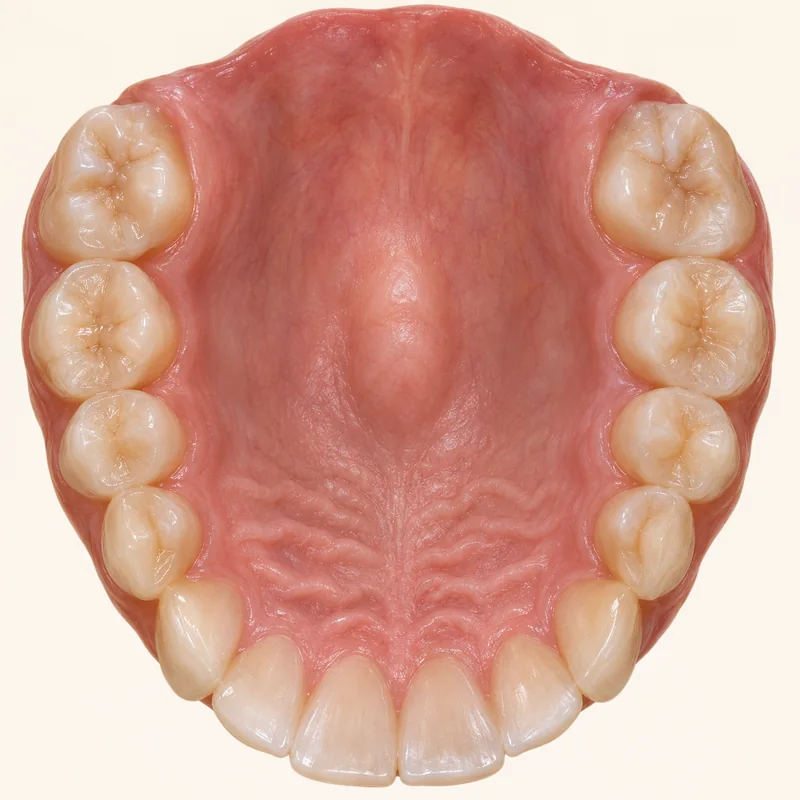
The hard palate forms the front, bony part of the roof of the mouth. A palatal torus projects beneath its lining. Its size and shape can vary.
The prominence consists of bone. The lining over it can become sore after mechanical irritation. A new or painful change needs professional assessment.
A confirmed torus without symptoms often needs no treatment. If it interferes with a denture, for example, the next steps are planned individually.
Yes, it may be found without causing symptoms.
Any investigations depend on the actual findings.
Existing reports and the affected denture, if available.
Three steps. No audio.
Each scene can also be selected manually.

Silent educational film with German on-screen text and simplified teaching images. Not a patient case or a promised treatment outcome. The full English explanation is available as text.
A torus mandibularis is on the inner side of the lower jaw. Torus palatinus refers to a prominence on the hard palate.
A confirmed torus is benign. The name should not be assigned from a photograph alone. Unexplained, growing or injured areas need examination.
Not automatically. Symptoms and possible interference with a denture or another appliance matter more than size alone. Removal is discussed when there is a clinical reason.
The torus itself is a bony prominence, not an infection. The lining over it can nevertheless become irritated or injured.
You can bring this question to your appointment:
Has the prominence been clearly identified, and does it affect my appliance?
An unexplained prominence or uncomfortable pressure area can be assessed in person.
Discuss a palatal findingAppointment selection at DoctolibLocation, examination findings and the condition of the lining are assessed together. The illustration cannot replace an examination.
Editorial research: . General information, not an individual diagnosis or treatment recommendation. Teaching illustrations are simplified and do not depict a patient case.