Where is the gland?
Mainly beneath the lower jaw.

The submandibular gland lies mainly beneath the lower jaw and is present on both sides. Its duct travels forwards to the floor of the mouth, opening beside the tongue frenulum. It is distinct from the smaller sublingual gland.
For training & practice ↓
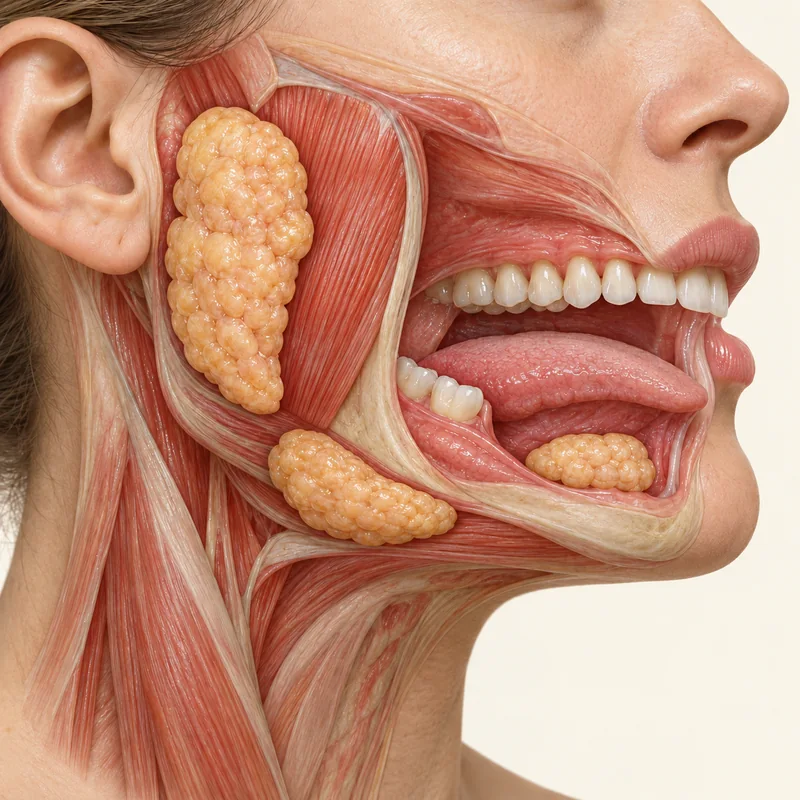
The name describes the gland location. Saliva then travels forwards through the floor of the mouth.
Wharton duct opens on a small elevation beside the tongue frenulum. This opening is not a tooth root or gum pocket.
Pain or swelling during meals may occur with obstructed flow. It does not prove a stone; examination clarifies possible causes.
Mainly beneath the lower jaw.
Whether swelling or pain is related to meals.
With fever, rapid swelling, swallowing or breathing difficulty.
Three steps. No audio.
Each scene can also be selected manually.

Silent educational film with German on-screen text and simplified teaching images. Not a patient case or a promised treatment outcome. The full English explanation is available below.
The name describes the gland location. Saliva then travels forwards through the floor of the mouth.
Wharton duct opens on a small elevation beside the tongue frenulum. This opening is not a tooth root or gum pocket.
Pain or swelling during meals may occur with obstructed flow. It does not prove a stone; examination clarifies possible causes.
The submandibular gland lies mainly beneath the jaw; the sublingual gland lies further forwards in the floor of the mouth beneath the tongue.
No. They are neighbouring but different glands with different duct systems.
Do not use sharp objects or forceful attempts. Have swelling and symptoms assessed.
A symptom alone cannot establish that. Treatment depends on cause, location and findings.
An editorially suggested question for a discussion with Dr med dent Niusha Barahmand Pour:
Is saliva drainage affected, and what further assessment is appropriate?
Symptoms beneath the jaw or tongue? Please call and describe pain, fever and any link with meals.
Call the practice · 0221 669 401 80Telephone contactThe submandibular gland lies mainly beneath the jaw; the sublingual gland lies further forwards in the floor of the mouth beneath the tongue.
Editorial research: . General information, not an individual diagnosis or treatment recommendation. Teaching illustrations are simplified and do not depict a patient case.