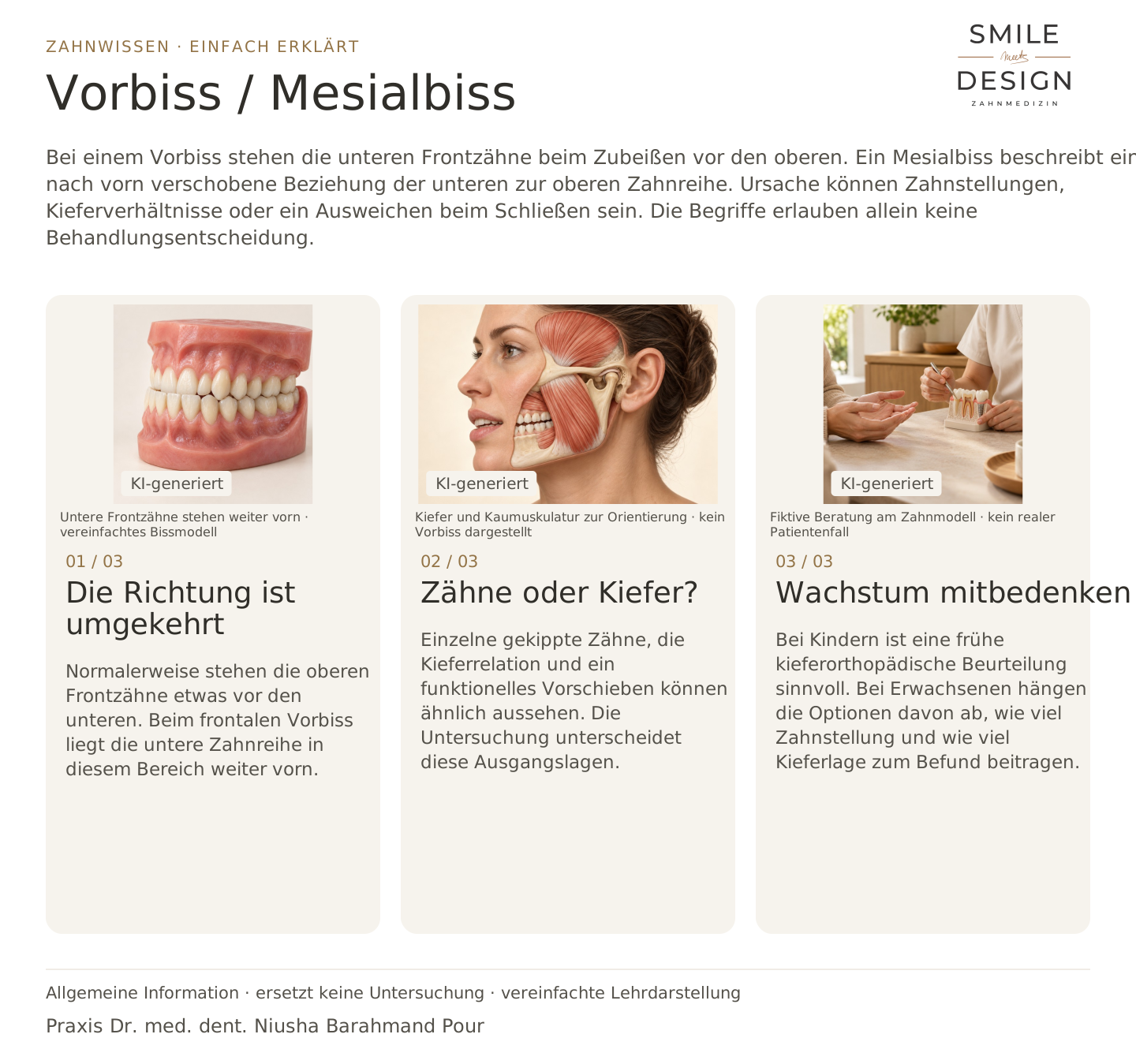
What is noticeable?
The lower front teeth sit ahead when biting together.

With an underbite, the lower front teeth meet in front of the upper teeth. A mesial bite describes a forward relationship of the lower to the upper dental arch. Tooth positions, jaw relationships or a shift on closing can contribute. These terms alone cannot determine treatment.
For dental trainees & teams
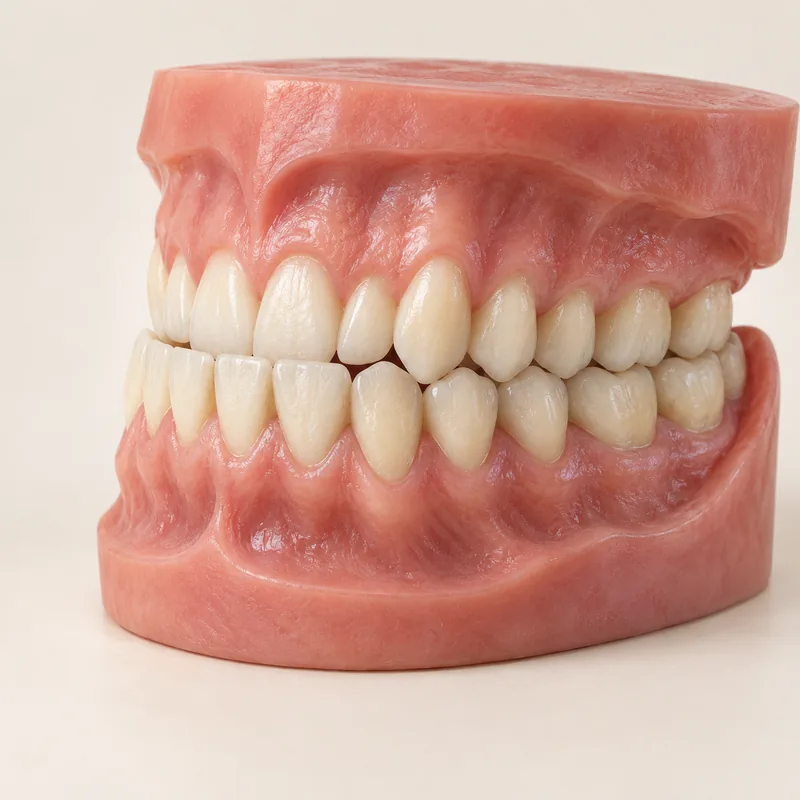
The upper front teeth usually sit slightly ahead of the lower teeth. In an anterior underbite, the lower teeth are further forward in this region.
Tilted teeth, jaw relationships and a functional forward shift can look similar. Examination distinguishes these different starting points.
Early orthodontic assessment is useful in children. In adults, options depend on how much tooth position and jaw relationship each contribute to the finding.
The lower front teeth sit ahead when biting together.
Tooth position, jaw relationship and a functional shift.
Early when the underbite is noticeable, especially during growth.
Three steps. Straight to the point.
Explanations are also shown on screen.

Silent film in German · English explanations in the three views above
Underbite usually describes a reversed front-tooth relationship. Crossbite is a broader term for reversed tooth contacts and can also affect back teeth.
No. A retrusive upper jaw, tooth inclinations or a forward shift of the lower jaw can also contribute. A profile photograph cannot reliably identify one cause.
Not without assessment. Some underbites are assessed early because growth and function matter to planning. Early assessment does not automatically mean immediate treatment.
No. Different orthodontic approaches may be possible depending on the cause. Marked skeletal discrepancies in adults may call for discussion of combined orthodontic and jaw-surgical care.
A question to discuss with Dr. med. dent. Niusha Barahmand Pour:
How much do tooth position, jaw relationship and function contribute to the underbite, and when would specialist assessment help?
Symptoms, examination findings and personal wishes form the basis of individual treatment planning.
An unusual front-tooth relationship deserves a precise assessment.
Discuss tooth and jaw positionChoose an appointment on DoctolibBuild on the simple explanation with clinical terms, key distinctions and a knowledge question.
Angle Class III describes a particular front-to-back dental relationship but does not by itself prove an enlarged lower jaw. Dental and skeletal components are assessed separately.
Editorial research: 23 October 2026. This explanation covers general principles and does not replace a personal examination. Suitable treatment is discussed following individual assessment.