Which ingredients matter?
Ingredients with a clear purpose; fluoride is well established for cavity prevention.

Toothpaste supports cleaning and delivers ingredients to tooth surfaces. Fluoride has well-established evidence for preventing decay. Other ingredients and abrasiveness should suit age, teeth and symptoms.
For dental trainees & teams
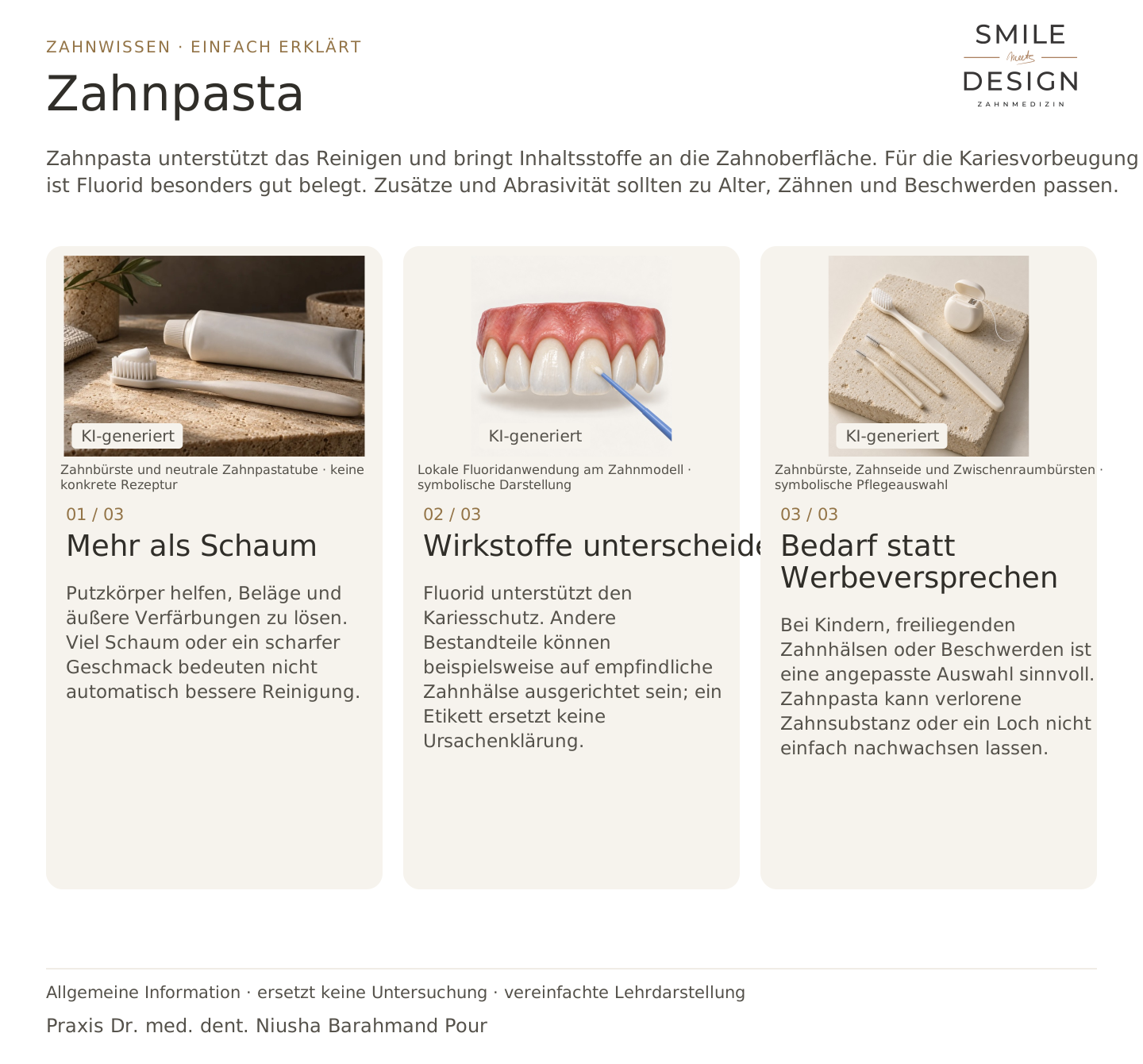
Cleaning particles help remove deposits and external stains. More foam or a stronger flavour does not automatically mean better cleaning.
Fluoride supports cavity prevention. Other ingredients may target sensitive exposed dentine, for example; a label cannot identify the cause of symptoms.
Children, exposed root surfaces and sensitive teeth may need a tailored choice. Toothpaste cannot simply regrow missing tooth structure or fill a cavity.
Ingredients with a clear purpose; fluoride is well established for cavity prevention.
Age, sensitivity and cavity risk help guide the choice.
Fill a cavity or replace assessment of pain.
Three steps. Straight to the point.
Explanations are also shown on screen.

Silent film in German · English explanations in the three views above
Toothpaste supports cleaning and, depending on its ingredients, protection. It does not automatically repair an existing structural defect.
No. It often mainly removes external stains. Lightening the tooth substance itself is a different procedure.
No. Fluoride toothpaste is an established cavity-prevention measure, used in an age-appropriate way.
The amount and fluoride concentration depend on age and guidance. Do not automatically use an adult-sized amount.
A question to discuss with Dr. med. dent. Niusha Barahmand Pour:
Which toothpaste suits my teeth and current cleaning routine?
Individual findings are the basis for discussing appropriate next steps.
Sensitivity or uncertainty about products is a useful reason to review everyday care.
Discuss individual careChoose an appointment on DoctolibBuild on the simple explanation with clinical terms, key distinctions and a knowledge question.
The number of advertised additives does not tell you whether a product suits an individual dental situation.
Editorial research: 23 October 2026. This explanation covers general principles and does not replace a personal examination. Suitable treatment is discussed following individual assessment.