
Dental insights · Aesthetics
One tooth is getting darker: why the cause comes first
One front tooth suddenly looks greyer or darker than its neighbours. Perhaps you notice it in a photograph or when looking in the mirror. Wanting a more even colour is understandable. Before choosing a whitening product, however, it is important to find out what has changed in this tooth. This article concerns permanent teeth.
Published on
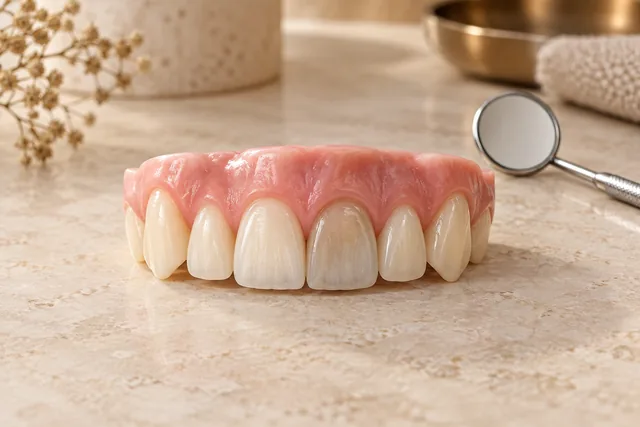 AI-generated
01 A difference in colour can have several causes
Pigments from coffee, tea or tobacco can build up on the tooth surface. A change can also originate inside the tooth, for example following an injury. Shades that look similar from the outside therefore do not necessarily have the same cause. ADA: Tooth colour
Tooth decay can also cause white, brown or black spots and may initially cause no symptoms. A dark spot does not, however, prove that decay is present. It is a reason for an examination, rather than a diagnosis made in the mirror. NHS: Tooth decay
Try to describe exactly what you notice: does it affect the whole visible tooth surface, a limited patch or the area around an existing filling? This observation helps the discussion but does not replace an examination.
02 An earlier impact is also part of the history
When preparing for your appointment, think about any fall, sports accident or blow to the tooth, even if it happened a long time ago. Changes inside a tooth after an injury can be present without acute symptoms. The German S2k guideline also describes different healing responses, including a yellowish discolouration caused by additional hard tissue formation. The colour alone therefore does not automatically mean that the tooth has lost its vitality or needs root canal treatment. DGMKG/DGZMK: Dental trauma
If the accident has only just happened, have the tooth examined by a dentist immediately. Do not wait for a change in colour; neighbouring teeth may also have been injured without it being obvious. AAE: Dental injuries
03 What the assessment brings together
After a possible injury, the history and several findings are assessed together. These may include checking for cracks or looseness, the response to cold and tenderness to tapping. A single test does not decide the outcome on its own: immediately after trauma, the response to a pulp sensibility test may be temporarily absent. Which X-ray is needed depends on the suspected problem and the question being investigated. DGMKG/DGZMK: Dental trauma
Feel free to ask for the findings to be explained in plain language: what is the likely cause? Is a follow-up assessment still needed? Does anything need to be treated first? This helps you understand why a colour correction may be recommended now, later or not for the time being.
04 Can just this one tooth be whitened?
In principle, whitening can also be targeted at a single tooth. For a tooth that has already had root canal treatment, internal bleaching may be an option under certain conditions, with whitening also taking place from inside the tooth. The existing root canal treatment is assessed first. This is an option in dentistry; whether it is suitable for your tooth and available to you needs to be discussed individually. Leeds NHS: Tooth whitening
The change in colour cannot be predicted with certainty. The tooth may darken again later. Risks include sensitivity and gum irritation; internal techniques also carry a rare risk of loss of root tissue. Accepting a colour that does not pose a dental health concern is another possible decision. Leeds NHS: Tooth whitening
05 When to seek prompt help
Arrange an examination for a newly noticed change in colour, even if there is no pain. If severe pain, swelling or fever develop, seek urgent dental care. Breathing or swallowing difficulties require immediate emergency medical help. Bleaching does not treat these symptoms. NHS: Dental abscess
A few notes are enough for the discussion: when did you first notice the difference? Are there any symptoms? Has the tooth been injured, filled or root-treated? You can bring any records you already have. Also describe what you would like to change: is it this one tooth or your overall tooth colour? A personal consultation brings these wishes together with the findings and a treatment plan you can understand.
More about tooth whitening and in our article about natural tooth colour.
Sources and further information
General information based on the professional sources listed below. Sources reviewed: 9 October 2026. Your individual situation is assessed during an examination.