
Dental insights · Tooth alignment
Five questions before aligner treatment.
Clear aligners may seem straightforward at first glance. Behind them is individually planned tooth movement. These five questions help you understand the options, commitment and limitations before deciding.
Editorial review: September 2026
01 What can be changed in my case?
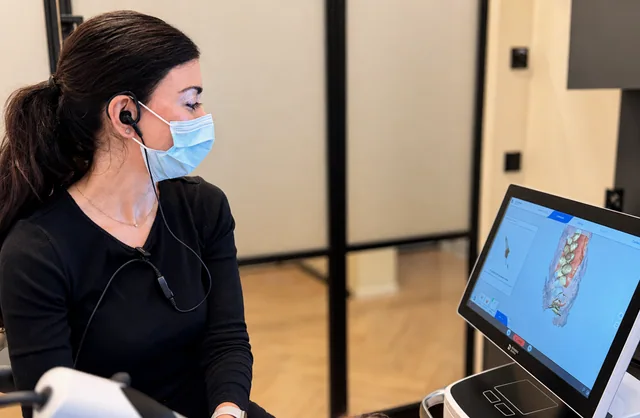
Perhaps a gap or a crowded front tooth bothers you. Sound planning needs more than this single view of your smile. The relationship between the upper and lower jaws and the condition of your teeth and gums also need examination. Some movements can be planned well with aligners; others may require additional measures or a different treatment.
Ask specifically: what is a realistic aim given my findings? What are the limitations? Which alternatives are suitable? An on-screen visualisation shows a planned course. It does not guarantee that your teeth will move exactly that way or within exactly that time.
02 Does treatment fit my everyday life?
Aligners are removable, but they only work while worn for the prescribed time. Daily wear time and the change to the next aligner depend on the system, your plan and actual progress. They are removed for eating and oral care.
Discuss how this can fit with meals, work and habits. Equally important: how do I clean my teeth and aligners? What should I do if an aligner does not fit, gets lost or is difficult to wear? Ask who to contact and what checks are planned. Skipping aligners on your own initiative is not part of the agreed plan.
03 What additional steps and risks are there?
Sometimes small tooth-coloured additions are needed on individual teeth. These “attachments” help support certain movements. For some crowding, limited enamel reduction between teeth may be considered to create space. Neither is an automatic part of every treatment.
Ask about the need, extent and alternatives beforehand. The explanation also includes possible discomfort and individual risks. Tooth roots can shorten during movement, for example; inadequate cleaning promotes decay and gum problems. A consultation should therefore do more than show the desired outcome: it should also explain what needs particular attention in your case.
04 What is included in the time and cost plan?
A useful plan describes more than a number of aligners. Ask for an estimated timeframe and what happens if progress differs from the plan. Depending on progress, additional checks, revised planning or further aligners may be needed.
- Which examinations and checks are planned?
- How are any additional aligners charged?
- Are stabilisation measures and their checks included?
- What other costs might arise?
Ask for a clear explanation of your individual cost plan. Clarify possible reimbursement under your insurance policy. A low starting price alone says little about the total costs.
05 How will the new tooth positions be maintained?
Care does not end with the last active aligner. Teeth can shift again. Subsequent stabilisation, also called retention, should therefore be discussed before treatment starts. Depending on the situation, removable or fixed retainers may be suitable.
Clarify how long and how often to wear a retainer, how to clean and check it and what to do if it is damaged. This is a long-term phase. It is as much a part of your decision as the tooth movement itself.
Bring your questions.
Learn more about the process, options and everyday life with aligners at our practice on our treatment page. We discuss personally what may be suitable for you.
Book an aligner consultationOnline booking opens Doctolib.
Clinical sources
General information; choosing a method and assessing personal risks require an individual examination.
- British Orthodontic Society: Clear aligners – requirements, use and limitations.
- British Orthodontic Society: Questions before teeth straightening – planning, cost questions and retention.
- British Orthodontic Society: Risks of orthodontic treatment (PDF) – clinical context for possible risks.