
Dental knowledge · Tooth replacement
Caring for dental implants: a routine for daily life and follow-up
Implants need daily cleaning and regular professional follow-up. The implant itself cannot develop decay, but the surrounding tissues can become inflamed. Care needs to suit the crown, bridge or denture. This guide covers long-term care after healing. Immediately after surgery, follow the personal instructions from your treating team.
Published on
 AI-generated
In this guide
Why an artificial tooth still needs care
Bacterial plaque can collect on crowns and around their edges. Peri-implant mucositis is inflammation of the soft tissues around an implant. Peri-implantitis also affects the supporting bone. Looking in a mirror cannot reliably distinguish the two.
Good cleaning is an important foundation, but does not replace an examination. Inflammation does not automatically mean that an implant is lost. Early assessment, the actual findings and suitable treatment matter.
European Federation of Periodontology: Peri-implant diseases · Kassenzahnärztliche Bundesvereinigung: Implantate, Stand April 2022
Clean accessible surfaces with a toothbrush
Clean accessible surfaces twice daily for about two minutes. Manual and powered toothbrushes are both options; suitable technique and access matter. Work systematically around the outer, inner and chewing surfaces without pressing hard against the gumline.
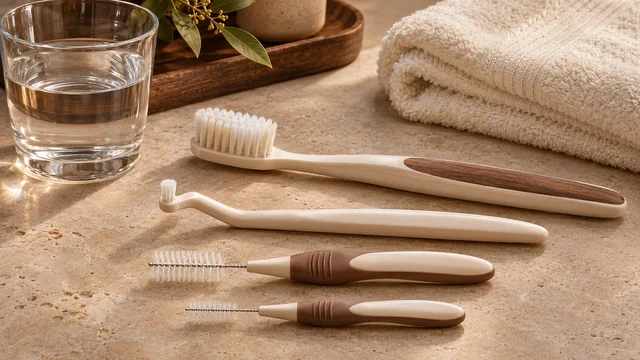
A small single-tuft brush can help with difficult-to-reach areas. Ask for a demonstration on your restoration. If hand movements are difficult or access beneath a bridge is poor, the routine needs adapting. More pressure does not solve an access problem.
British Society of Periodontology and Implant Dentistry: Caring for your implant, 2023 · Deutsche Gesellschaft für Implantologie: Patientenbroschüre, 2022, gedruckte Seiten 24–25
Choose interdental aids that fit
Interdental brushes should reach the space without being forced through or having the wire rub against the restoration. Different sites may need different sizes. Ask to be shown the size, entry direction and movement rather than choosing solely by the colour on a shelf.
Floss is not universally prohibited. Its suitability depends on factors including the restoration and surface. It can fray on exposed rough implant threads, where another aid may be more appropriate. Do not push threads deeply beneath the tissues. Have the area checked if floss repeatedly catches.
Scottish Dental Clinical Effectiveness Programme: Implant oral hygiene
Distinguish fixed from removable restorations
A single implant crown, a fixed bridge and a removable implant-supported denture have different cleaning routes. A denture designed for removal is taken out for cleaning as instructed. Do not unscrew fixed crowns or bridges yourself. Ask for a practical demonstration of accessible undersides and connection areas.
Material and design also determine how the denture itself should be cleaned. Instructions for an acrylic denture cannot be transferred unchanged to every fixed ceramic restoration. A short, clear guide for your particular restoration is therefore useful.
Leeds Teaching Hospitals NHS Trust: Dental Implants, reviewed 4 June 2025 · Scottish Dental Clinical Effectiveness Programme: Implant oral hygiene
Plan follow-up around individual risk
A check-up can include plaque, bleeding on gentle examination, tissue changes, the restoration and comparison with previous findings. An X-ray complements the examination when indicated. It is not automatically required at every visit or simply because a calendar year has passed.
Previous periodontitis, current oral hygiene and access around the restoration influence follow-up needs. Smoking and diabetes also belong in the discussion. Improving blood-glucose control and obtaining support to stop smoking are beneficial to health; the exact reduction in an individual implant risk cannot be predicted.
FDI Consensus Report: Diagnosis and non-surgical treatment of peri-implant diseases and maintenance care of patients with dental implants, 2019; DOI 10.1111/idj.12490 · Herrera et al.: Prevention and treatment of peri-implant diseases—The EFP S3 level clinical practice guideline, 2023 · European Federation of Periodontology: Peri-implant disease prevention
Raise changes early
Repeated bleeding, red or swollen tissues, pus, an unusual taste or new symptoms should be examined promptly. Tissues can develop disease without significant pain at first. Regular check-ups therefore matter even when everything feels comfortable.
Contact the practice promptly if an implant or its restoration feels loose. A loosened connection and a problem with the implant body are different possibilities; twisting it yourself will not establish the cause. Do not wait for a routine follow-up if symptoms noticeably worsen.
British Society of Periodontology and Implant Dentistry: Caring for your implant, 2023 · European Federation of Periodontology: Peri-implant diseases · US Food and Drug Administration: Dental Implants—What You Should Know
Bring a specific question to your appointment
Mouthwash replaces neither mechanical cleaning nor treatment of inflammation. Use antiseptic products selectively as instructed. Trying to reach beneath a restoration with tools or scrape a suspected pocket is not safe home care.
Bring your implant record or available documentation and the cleaning aids you use. Note which site is hard to reach and when symptoms started. You can arrange an assessment at SMILE meets DESIGN in Cologne and mention the reason in advance. The findings determine which examination or further care is appropriate.
European Federation of Periodontology: Peri-implant disease treatment · Herrera et al.: Prevention and treatment of peri-implant diseases—The EFP S3 level clinical practice guideline, 2023 · US Food and Drug Administration: Dental Implants—What You Should Know
Common questions
Do I need a special implant toothpaste?
A particular specialist brand is not a general requirement. Suitable aids and correct use matter. Remaining natural teeth still need decay prevention with fluoride toothpaste; choose products that suit the mouth as a whole.
Deutsche Gesellschaft für Implantologie: Patientenbroschüre, 2022, gedruckte Seiten 24–25 · American Dental Association, MouthHealthy: Brushing Your Teeth
How often do I need an implant check-up?
This is decided individually. Following treatment of peri-implant disease, closer follow-up may be needed than when conditions are stable. A single interval for all implants would therefore be inappropriate.
Can I treat inflammation myself with mouthwash?
Do not rely on that. The cause and extent need examination. Professional cleaning and any further treatment are planned from the findings; a rinse is at most a selectively used adjunct.
European Federation of Periodontology: Peri-implant disease treatment
Why have a check-up if nothing hurts?
Disease around implants can initially develop without obvious symptoms. Examination and comparison with previous findings can reveal changes that cannot be reliably assessed at home.
British Society of Periodontology and Implant Dentistry: Caring for your implant, 2023 · FDI Consensus Report: Diagnosis and non-surgical treatment of peri-implant diseases and maintenance care of patients with dental implants, 2019; DOI 10.1111/idj.12490
Related reading
Sources and further reading
Research and editorial date: 7 November 2026. General information; individual findings and recommendations require an examination.
- Kassenzahnärztliche Bundesvereinigung: Implantate, Stand April 2022
- British Society of Periodontology and Implant Dentistry: Caring for your implant, 2023
- Deutsche Gesellschaft für Implantologie: Patientenbroschüre, 2022, gedruckte Seiten 24–25
- Scottish Dental Clinical Effectiveness Programme: Implant oral hygiene
- Leeds Teaching Hospitals NHS Trust: Dental Implants, reviewed 4 June 2025
- European Federation of Periodontology: Peri-implant diseases
- FDI Consensus Report: Diagnosis and non-surgical treatment of peri-implant diseases and maintenance care of patients with dental implants, 2019; DOI 10.1111/idj.12490
- Herrera et al.: Prevention and treatment of peri-implant diseases—The EFP S3 level clinical practice guideline, 2023
- European Federation of Periodontology: Peri-implant disease prevention
- European Federation of Periodontology: Peri-implant disease treatment
- US Food and Drug Administration: Dental Implants—What You Should Know
- American Dental Association, MouthHealthy: Brushing Your Teeth