What is assessed?
Gums, supporting tissues and, where indicated, bone on X-rays.

Alveolar bone is the tooth-bearing part of the upper and lower jaws. It forms sockets around the roots. Teeth attach through fibres of the supporting tissues rather than being rigidly fused to bone.
For training & practice ↓
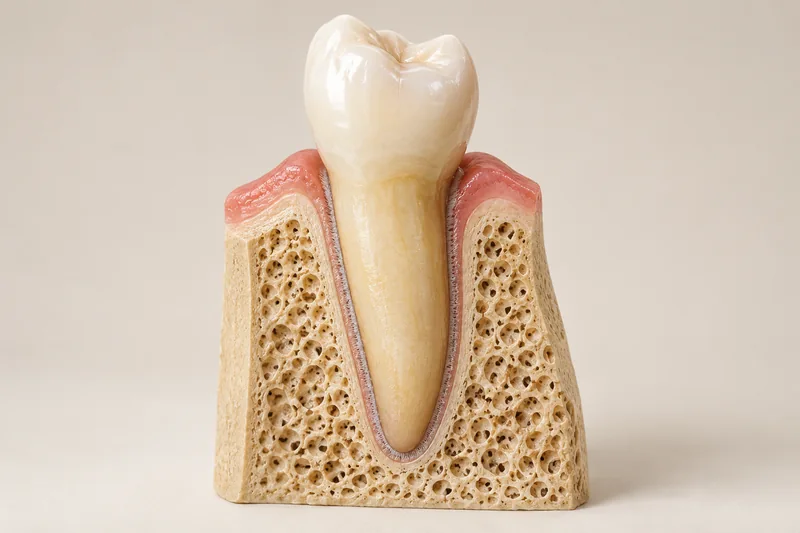
A bony wall surrounds the socket. A narrow region containing fibres, vessels and nerves lies between root and bone.
Bone is continually remodelled. Its shape can also change after tooth loss; an X-ray is only part of assessment.
Periodontitis can destroy supporting tissue, including bone. Assessment, treatment and follow-up matter; lost bone does not automatically regrow completely.
Gums, supporting tissues and, where indicated, bone on X-rays.
In periodontal disease, tooth loss or planning replacement teeth.
To protect existing support and plan suitable care.
Three steps. No audio.
Each scene can also be selected manually.

Silent educational film with German on-screen text and simplified teaching images. Not a patient case or a promised treatment outcome. The full English explanation is available below.
A bony wall surrounds the socket. A narrow region containing fibres, vessels and nerves lies between root and bone.
Bone is continually remodelled. Its shape can also change after tooth loss; an X-ray is only part of assessment.
Periodontitis can destroy supporting tissue, including bone. Assessment, treatment and follow-up matter; lost bone does not automatically regrow completely.
Gums cover the tooth-bearing jaw region. The underlying bone is a different tissue.
No. Enamel belongs to the crown; alveolar bone belongs to the jaw around roots.
No. Symptoms alone cannot reliably show its condition. Gum assessment and justified X-rays complement one another.
No. Cause, extent and treatment goal matter; not every defect can be reconstructed.
An editorially suggested question for a discussion with Dr med dent Niusha Barahmand Pour:
Where is the bone affected, and what does that mean for this tooth?
A report mentions bone loss? Ask which region is affected and what matters for preserving support.
Discuss tooth supportAppointment selection at DoctolibGums cover the tooth-bearing jaw region. The underlying bone is a different tissue.
Editorial research: . General information, not an individual diagnosis or treatment recommendation. Teaching illustrations are simplified and do not depict a patient case.