For every tooth?
No; mainly immature permanent teeth with non-vital pulp.

Apexification promotes a barrier at the open root end of an immature permanent tooth with a necrotic pulp. A related approach creates the closure with an apical material plug. This supports subsequent root filling but does not replace normal root development.
For training & practice ↓
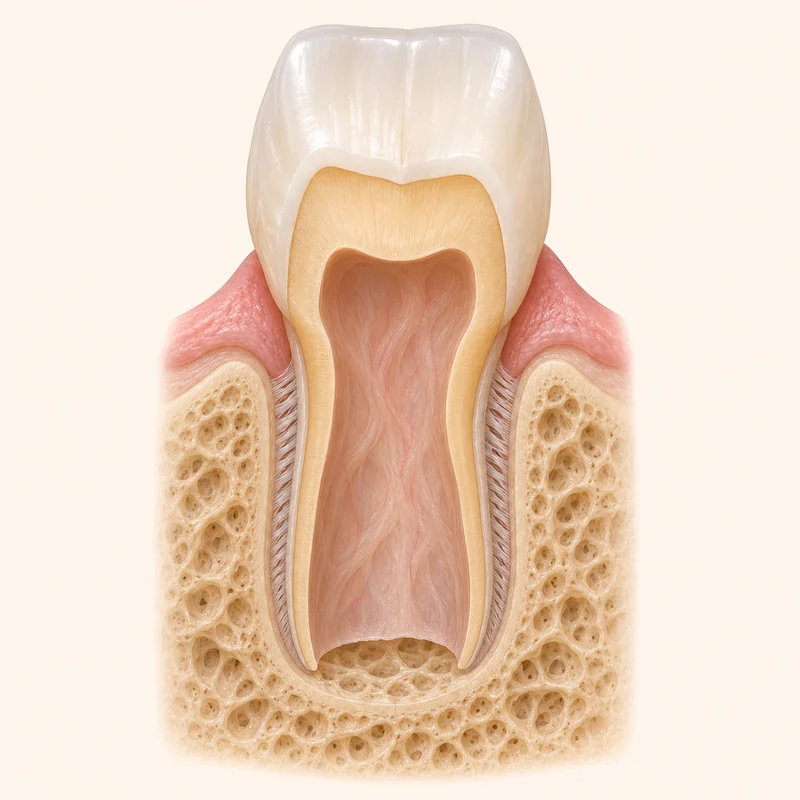
If pulp dies before root formation finishes, a wide opening and thin root walls may remain. Disease and the tooth’s suitability for preservation are assessed first.
Following cleaning and disinfection, closure is achieved through induced hard-tissue formation or a suitable calcium silicate cement plug. The approach is chosen individually.
Further root filling, a well-sealed restoration and follow-up form part of treatment. An apical plug does not automatically make thin root walls continue growing.
No; mainly immature permanent teeth with non-vital pulp.
No; the approach and suitability matter.
Clinical assessment and imaging according to the plan.
Three steps. No audio.
Each scene can also be selected manually.

Silent educational film with German on-screen text and simplified teaching images. Not a patient case or a promised treatment outcome. The full English explanation is available as text.
Closure supports root filling. Whether a root gains length or wall thickness is a separate question.
No. Apicectomy surgically removes part of a root tip. Here the aim is closure at an open root end.
Apexogenesis is continued root development with a living pulp. Apexification concerns a tooth with non-vital pulp.
No. It is another option for selected immature teeth, aiming at further tissue development. Evidence comparing tooth survival and treatment success between approaches is of low certainty. Results vary; a completely new pulp or completed root maturation cannot be promised.
You can bring this question to your appointment:
Which barrier or alternative fits the root development, and how will the tooth be monitored?
An examination can clarify the finding and any need for referral.
Arrange an assessmentAppointment selection at DoctolibClosure supports root filling. Whether a root gains length or wall thickness is a separate question.
Editorial research: . General information, not an individual diagnosis or treatment recommendation. Teaching illustrations are simplified and do not depict a patient case.