What is its defining feature?
It is developed for thicker increments; permitted thickness remains product-specific.

Bulk-fill composite is a tooth-coloured restorative resin composite developed for thicker increments than many conventional composites. This may simplify some placement steps. It does not mean that a cavity of any depth can be filled in one go. Material, permitted increment thickness and light curing must be compatible; the specific product instructions and clinical findings guide the approach.
For training & practice ↓
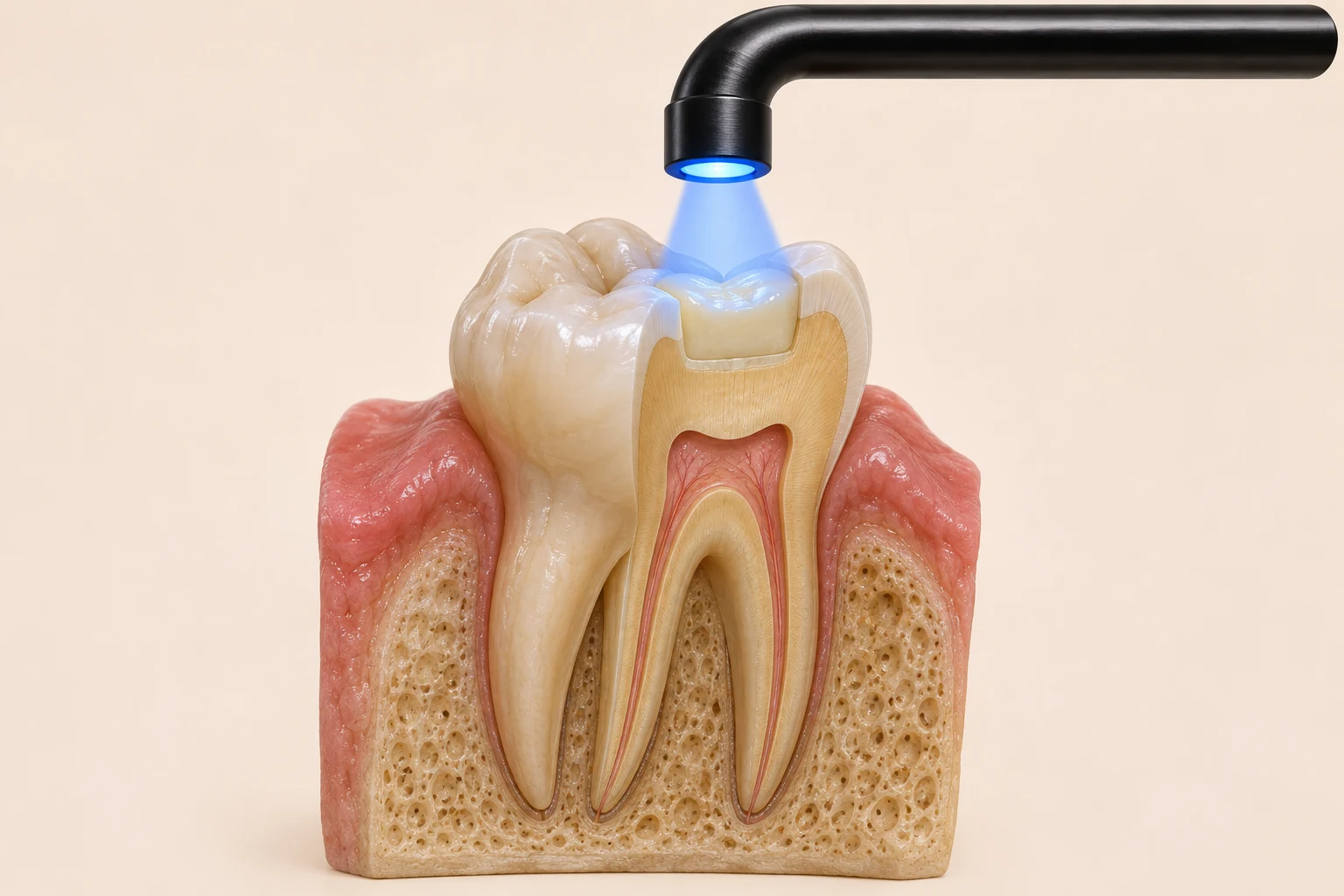
Composite is placed in a prepared cavity and cured with light. Bulk-fill materials are designed for thicker increments. Permitted thickness is nevertheless product-specific. The name does not allow an unlimited amount of material to be placed at once.
Curing depends on material, layer thickness and light application. Laboratory measurements varied with depth. A suitable light, correct positioning and specified exposure remain important. Surface appearance alone does not prove adequate curing below the surface.
Bulk-fill fillings need careful bonding, suitable tooth contacts, shaped margins and a bite check. One trial found acceptable five-year outcomes for two tested materials. This does not promise the same result for every product or a particular lifespan for your filling.
It is developed for thicker increments; permitted thickness remains product-specific.
Clinical findings, bonding, shaping and controlled curing.
Universal suitability, a fixed appointment length or guaranteed longevity.
Three steps. No audio.
Each scene can also be selected manually.

Silent educational film with German on-screen text and simplified teaching images. Not a patient case or a promised treatment outcome. The full English explanation is available as text.
Bulk-fill identifies materials designed for thicker increments. They still have defined handling instructions and thickness limits. “Bulk” does not mean “without rules” or “always in a single step”.
Both are resin composite materials used for fillings. Bulk-fill products are developed for thicker increments. Specific compositions and handling differ between products, so they are not freely interchangeable.
No. Cavity depth and shape, together with product instructions, determine placement. A bulk-fill material must not be placed in increments thicker than suitable for that particular product and curing procedure.
A five-year randomized trial found acceptable clinical results for the materials compared in that study. This does not establish blanket equivalence across all products. Clinical findings, technique, loading and subsequent oral care affect an individual restoration.
No. Incremental placement is only one part of treatment. Bonding, isolation, shaping, tooth contacts and checking the bite remain important. Fewer increments do not guarantee a particular appointment length or quality.
No. Laboratory findings show why material and curing conditions need careful attention. They cannot be directly translated into an individual health risk or a blanket verdict on all bulk-fill products.
You can bring this question to your appointment:
Which filling material suits this defect, and how are curing, contact points and the bite checked?
An individual examination can clarify the findings and suitable next steps.
Arrange an assessmentAppointment selection at DoctolibClinical longevity and laboratory measurements represent different levels of evidence. A depth-of-cure experiment alone cannot predict the lifespan of an individual filling, and a single clinical trial does not cover every product.
Editorial research: . General information, not an individual diagnosis or treatment recommendation. Teaching illustrations are simplified and do not depict a patient case.