Typical feature?
Deep overlap, often with inward-inclined upper incisors.

The German term Deckbiss describes marked covering of the lower incisors, commonly with inward-inclined upper incisors. Assessment considers vertical overlap, inclination, tooth contacts and jaw relationships. The term alone does not determine treatment.
For training & practice ↓
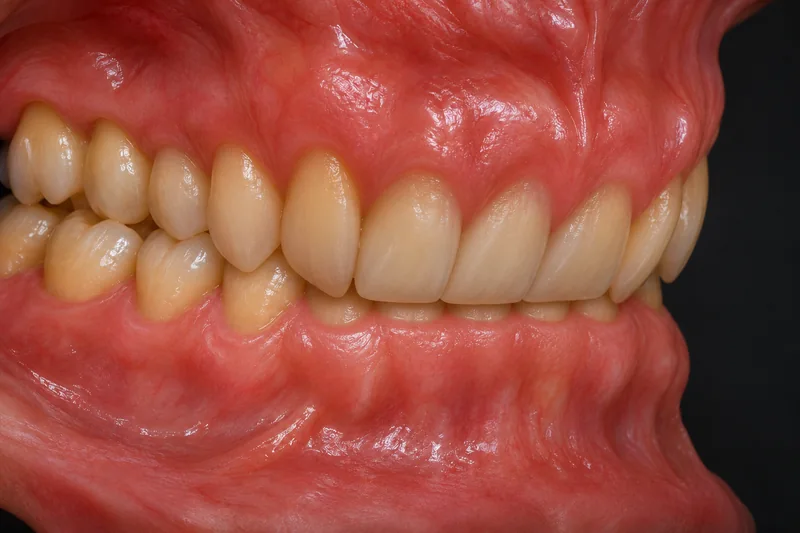
Upper incisors cover the lower incisors more than usual. In this pattern, upper incisor inclination is commonly altered as well.
Assessment includes posterior contacts, tooth inclination and possible soft-tissue contact. A large horizontal overjet is not essential to the pattern.
Symptoms, growth and function influence planning. Orthodontic assessment determines whether and how correction is appropriate.
Deep overlap, often with inward-inclined upper incisors.
No.
Consider teeth, bite and growth together.
Three steps. No audio.
Each scene can also be selected manually.

Silent educational film with German on-screen text and simplified teaching images. Not a patient case or a promised treatment outcome. The full English explanation is available below.
Upper incisors cover the lower incisors more than usual. In this pattern, upper incisor inclination is commonly altered as well.
Assessment includes posterior contacts, tooth inclination and possible soft-tissue contact. A large horizontal overjet is not essential to the pattern.
Symptoms, growth and function influence planning. Orthodontic assessment determines whether and how correction is appropriate.
Overbite is vertical incisor overlap. Overjet is the horizontal incisor distance. The horizontal distance can vary in a cover-bite pattern.
No. Deep bite identifies increased vertical overlap; Deckbiss describes a characteristic pattern often involving inward-inclined upper incisors.
No. Tooth inclination and posterior dental relationships require separate assessment; the terms are not equivalent.
Suitability depends on severity, growth and the intended changes. A photograph cannot determine the answer.
Editorially suggested question to discuss with Dr Niusha Barahmand Pour:
How do overlap, tooth inclination and jaw relationship differ in my situation?
Marked overlap or contact with the soft tissues can be discussed in a focused bite assessment.
Discuss the front-tooth biteAppointment selection at DoctolibOverbite is vertical incisor overlap. Overjet is the horizontal incisor distance. The horizontal distance can vary in a cover-bite pattern.
Editorial research: . General information, not an individual diagnosis or treatment recommendation. Teaching illustrations are simplified and do not depict a patient case.