Origin?
A variation in tooth development.

In dens invaginatus, the outer developing tooth folds inwards. A narrow pit may therefore extend deep into the tooth. The phrase tooth within a tooth is figurative: these are not two fully separate teeth.
For training & practice ↓
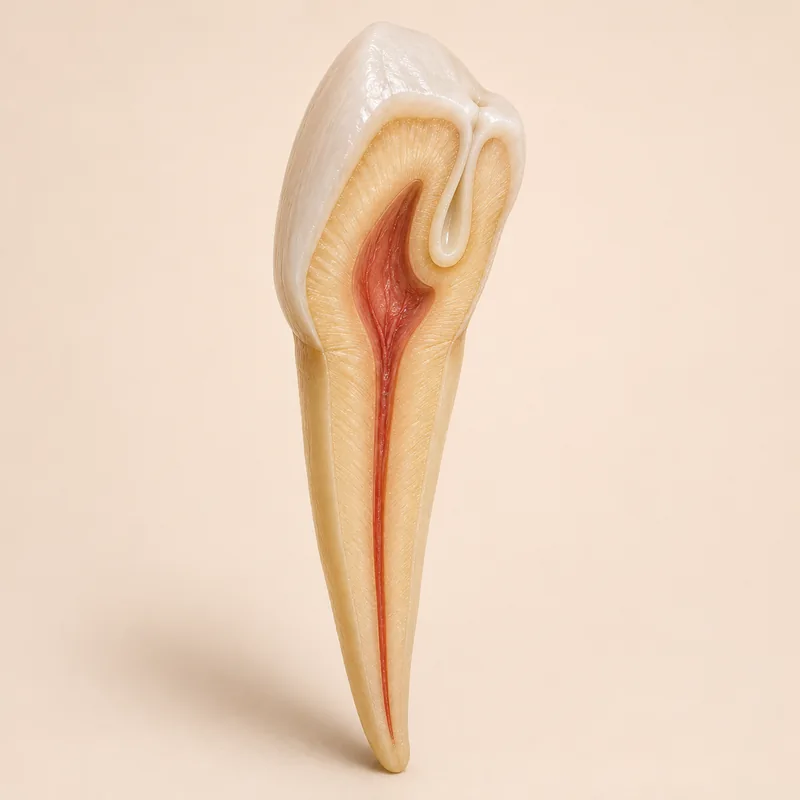
A small pit, often on the inner surface of an upper lateral incisor, may be a visible clue. Its depth cannot be judged reliably from outside.
The fold may be limited to the crown or extend further. Imaging is selected according to the clinical question.
Deep pits can be hard to clean. Protecting the entrance may be considered when the pulp is healthy; infection requires a different approach.
A variation in tooth development.
Hard-to-clean openings can favour infection.
Based on anatomy and pulp condition, not the name alone.
Three steps. No audio.
Each scene can also be selected manually.

Silent educational film with German on-screen text and simplified teaching images. Not a patient case or a promised treatment outcome. The full English explanation is available as text.
Dens invaginatus describes an inward-folded structure. Hyperdontia means extra teeth.
No. It can initially be symptom-free.
Not because of the name alone. Depth, openings and pulp condition matter.
Seek prompt assessment for new pain, swelling or a gum boil. Rapidly increasing swelling or swallowing difficulties need urgent help.
Editorially suggested question to discuss with Dr Niusha Barahmand Pour:
How far does the fold extend, and is the pulp healthy?
An unusual incisor pit can be assessed to determine whether protection or further investigation is needed.
Have a tooth pit assessedAppointment selection at DoctolibDens invaginatus describes an inward-folded structure. Hyperdontia means extra teeth.
Editorial research: . General information, not an individual diagnosis or treatment recommendation. Teaching illustrations are simplified and do not depict a patient case.