Where?
In the dentine.

Dentine caries is a carious lesion that has reached the tissue beneath enamel and around the pulp. Decisions depend on depth, activity, whether the surface has broken down and the condition of the pulp.
For training & practice ↓
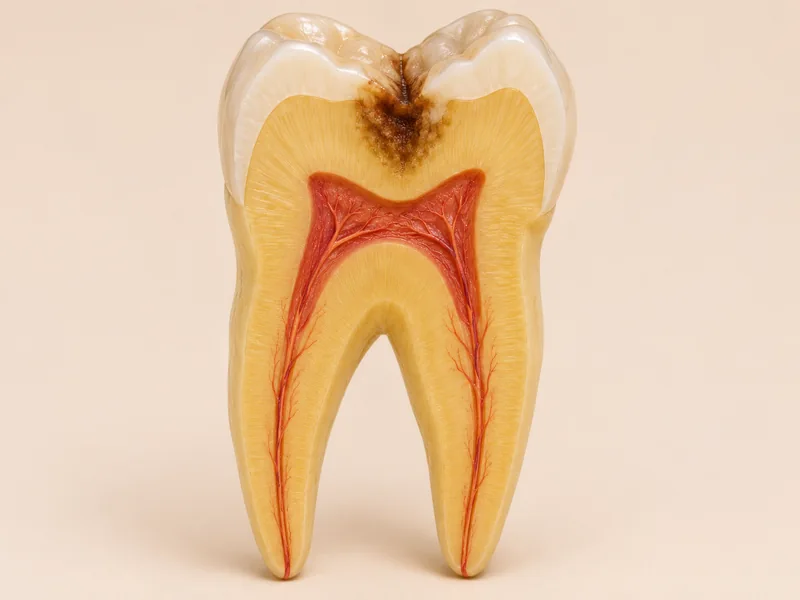
In a tooth section, dentine lies between enamel and pulp. The name identifies the affected tissue.
Symptoms, examination and appropriately indicated radiographs provide complementary information. Lack of pain does not establish lesion depth.
Management varies with the findings. Near the pulp, the amount of tissue removed requires particular care.
In the dentine.
No.
Discuss findings and preservation options.
Three steps. No audio.
Each scene can also be selected manually.

Silent educational film with German on-screen text and simplified teaching images. Not a patient case or a promised treatment outcome. The full English explanation is available below.
In a tooth section, dentine lies between enamel and pulp. The name identifies the affected tissue.
Symptoms, examination and appropriately indicated radiographs provide complementary information. Lack of pain does not establish lesion depth.
Management varies with the findings. Near the pulp, the amount of tissue removed requires particular care.
Enamel and dentine caries name affected hard tissues. Dentine involvement alone does not establish pulpal disease.
No. Dentine involvement does not automatically mean that the pulp must be removed.
Not reliably. The visible area may not show the full extent inside the tooth.
Good cleaning remains important. Examination determines whether sealing or restoration is also needed.
Editorially suggested question to discuss with Dr Niusha Barahmand Pour:
How close is the lesion to the pulp, and how does that affect treatment?
Understanding the finding in your own tooth can make treatment choices clearer.
Discuss a caries findingAppointment selection at DoctolibEnamel and dentine caries name affected hard tissues. Dentine involvement alone does not establish pulpal disease.
Editorial research: . General information, not an individual diagnosis or treatment recommendation. Teaching illustrations are simplified and do not depict a patient case.