For whom?
Selected deep lesions.

Selective caries removal uses different endpoints in different areas. In suitable deep lesions, softer dentine may deliberately remain near living pulp to avoid exposing it. The restoration margins still need a substrate that permits an effective seal.
For training & practice ↓
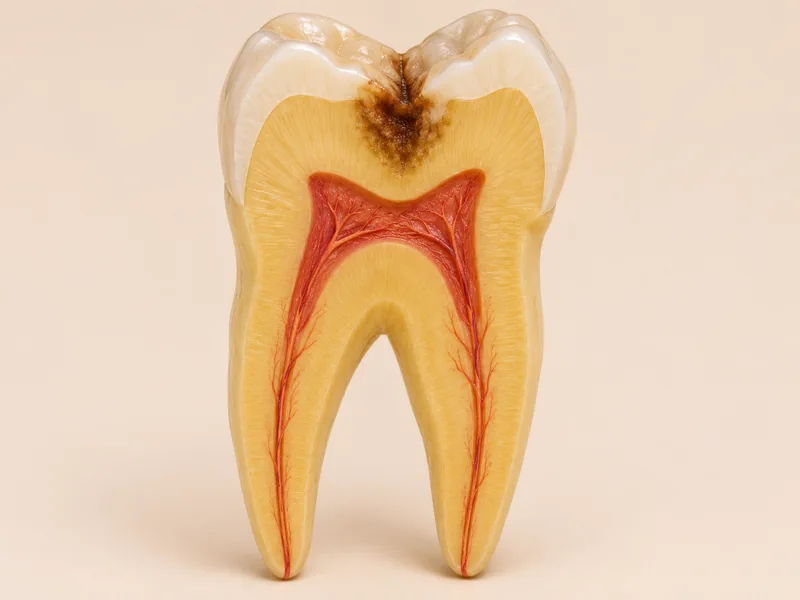
This is not suitable for every finding. Symptoms, examination and lesion depth guide planning.
The pulp-facing area is treated differently from the margins. This is controlled tissue preservation, not an untreated open cavity.
The tooth is appropriately restored and reviewed. An effective seal matters; the approach does not guarantee permanent pulp survival.
Selected deep lesions.
No.
No.
Three steps. No audio.
Each scene can also be selected manually.

Silent educational film with German on-screen text and simplified teaching images. Not a patient case or a promised treatment outcome. The full English explanation is available below.
This is not suitable for every finding. Symptoms, examination and lesion depth guide planning.
The pulp-facing area is treated differently from the margins. This is controlled tissue preservation, not an untreated open cavity.
The tooth is appropriately restored and reviewed. An effective seal matters; the approach does not guarantee permanent pulp survival.
Selective describes different tissue-removal endpoints by location. Stepwise describes a planned later re-entry.
Altered dentine may deliberately remain near the pulp as part of a planned and sealed treatment strategy.
Not necessarily. A planned two-visit procedure is called stepwise removal and is distinct.
No. Extremely deep lesions or substantial pulpal symptoms may require a different approach.
Editorially suggested question to discuss with Dr Niusha Barahmand Pour:
Which removal strategy fits the findings in my tooth?
With deep decay, discuss how remaining tooth tissue and pulp condition inform the plan.
Discuss tooth preservationAppointment selection at DoctolibSelective describes different tissue-removal endpoints by location. Stepwise describes a planned later re-entry.
Editorial research: . General information, not an individual diagnosis or treatment recommendation. Teaching illustrations are simplified and do not depict a patient case.