Always caused by injury?
No.

Tooth dilaceration is a pronounced developmental bend within a tooth, usually its root. One segment departs markedly from the long axis of the remaining tooth. Previous trauma may contribute but is not required. The shape matters when assessing eruption or planning root canal treatment or surgery; it does not automatically mean that the tooth must be removed.
For training & practice ↓
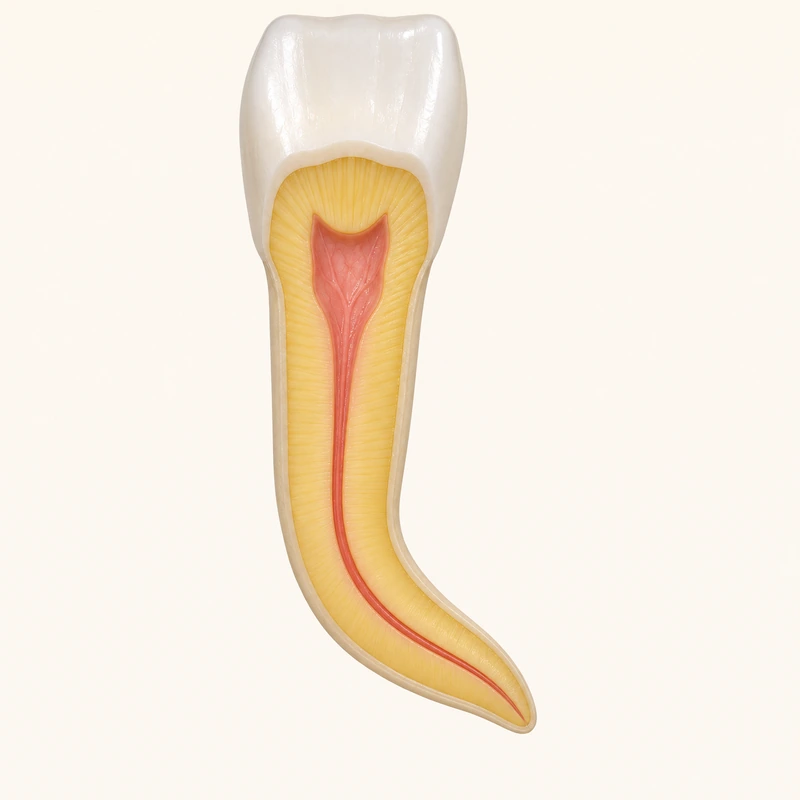
The teaching model shows a marked change of direction within the root. This differs from a whole tooth that is tilted or rotated in the dental arch.
An injury to a primary tooth may affect its developing permanent successor. Dilaceration can also occur without a known injury, and a single cause is not always identifiable.
Root shape and eruption path are assessed before treatment. Any imaging is chosen for the clinical question; a three-dimensional scan is not automatically necessary.
No.
No.
No; assess individually.
Three steps. No audio.
Each scene can also be selected manually.

Silent educational film with German on-screen text and simplified teaching images. Not a patient case or a promised treatment outcome. The full English explanation is available as text.
Dilaceration is a bend within the tooth itself. Rotation means that the whole tooth is turned around its long axis.
No. Trauma is one possible explanation but is not identified in every affected tooth. Shape alone cannot reliably reconstruct the history.
Braces can change a tooth’s position. They do not simply straighten an established bend in its hard root structure.
No. Symptoms, eruption, alignment and planned procedures determine the need. The shape may require no immediate treatment but can matter for future procedures.
You can bring this question to your appointment:
How does this root shape affect eruption, tooth preservation and any treatment being considered?
An individual assessment can clarify the findings and whether referral is needed.
Arrange an assessmentAppointment selection at DoctolibDilaceration is a bend within the tooth itself. Rotation means that the whole tooth is turned around its long axis.
Editorial research: . General information, not an individual diagnosis or treatment recommendation. Teaching illustrations are simplified and do not depict a patient case.
If you turn this on, this website stores which guides you open, separately from advertising preferences. The markers expire after a fixed 30-day period from activation. The list is not sent to us by this feature. You can turn it off here and delete the markers.
Other people using the same browser profile can also see the markers. German and English versions share one marker. Expired entries are removed the next time you open a page with this feature; deleting browser data may remove them earlier. “Viewed” means opened, not read or completed.