Who may find this helpful?
People wanting to understand an X-ray finding or proposed root canal treatment.

A root canal is a natural internal space within a tooth root. It forms part of the cavity system containing pulp, including nerves, blood vessels and connective tissue, in a vital tooth. The canal is neither the root itself nor automatically a disease-related defect.
For training & practice ↓
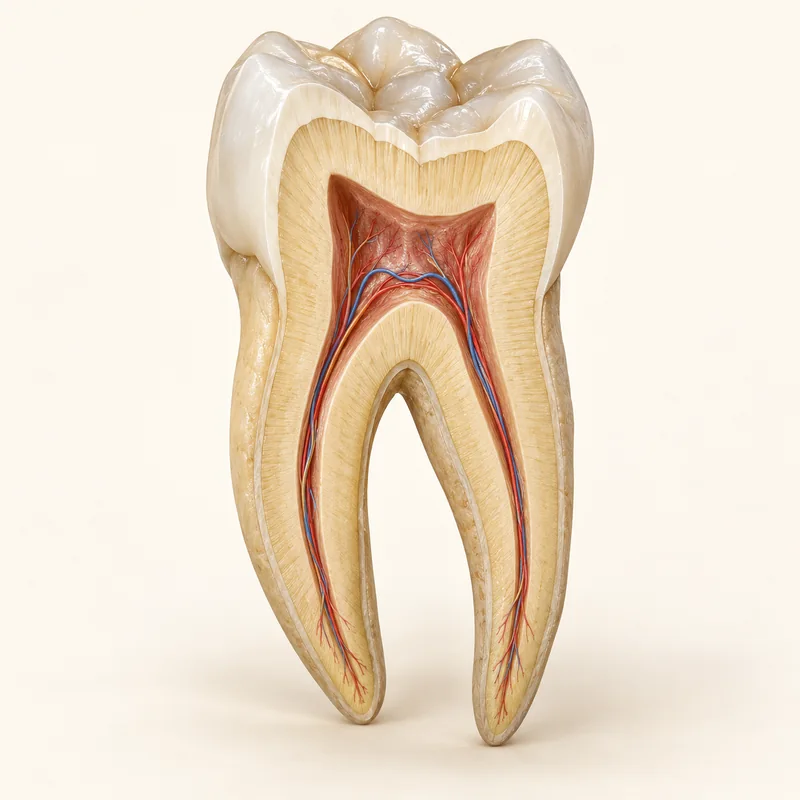
Pulp occupies a chamber in the crown and extends into the root canals. Hard tooth tissue surrounds this space; small openings connect it with tissues around the root.
Canals may be narrow, curved and branched. The number of roots does not necessarily equal the number of canals. Individual anatomy is considered during assessment and, where needed, treatment.
Disease of the pulp or tissues around the root may make treatment necessary. During root canal treatment, accessible canals are cleaned, disinfected and filled; the root normally stays in the jaw.
People wanting to understand an X-ray finding or proposed root canal treatment.
Root canal treatment treats the inside; it is not extraction.
For increasing pain, swelling or fever. Breathing or swallowing difficulty requires immediate medical help.
Three steps. No audio.
Each scene can also be selected manually.

Silent educational film with German on-screen text and simplified teaching images. Not a patient case or a promised treatment outcome. The full English explanation is available below.
Pulp occupies a chamber in the crown and extends into the root canals. Hard tooth tissue surrounds this space; small openings connect it with tissues around the root.
Canals may be narrow, curved and branched. The number of roots does not necessarily equal the number of canals. Individual anatomy is considered during assessment and, where needed, treatment.
Disease of the pulp or tissues around the root may make treatment necessary. During root canal treatment, accessible canals are cleaned, disinfected and filled; the root normally stays in the jaw.
The canal is an anatomical structure. Root canal treatment is a procedure for particular diseases affecting the tooth interior and root-tip area.
No. Shape and number vary; a root can contain more than one canal. A schematic drawing shows only one example.
No. Pulp also includes blood vessels and connective tissue. Calling it the tooth nerve is a simplification.
No. It may be visible as normal anatomy. Symptoms, tests and imaging findings are considered together.
An editorially suggested question for a discussion with Dr med dent Niusha Barahmand Pour:
What does the canal anatomy show, and which findings support the proposed treatment?
Has a root canal been mentioned? Ask which structure is meant and whether a finding needs treatment.
Discuss the tooth findingsAppointment selection at DoctolibThe canal is an anatomical structure. Root canal treatment is a procedure for particular diseases affecting the tooth interior and root-tip area.
Editorial research: . General information, not an individual diagnosis or treatment recommendation. Teaching illustrations are simplified and do not depict a patient case.