Direction?
Front-to-back relationship of dental arches.

Distal occlusion describes a posterior dental relationship in which the lower arch lies further back relative to the upper arch than in a neutral relationship. Tooth positions and bony jaw relationships may contribute differently. Increased overjet can occur but is not the definition.
For training & practice ↓
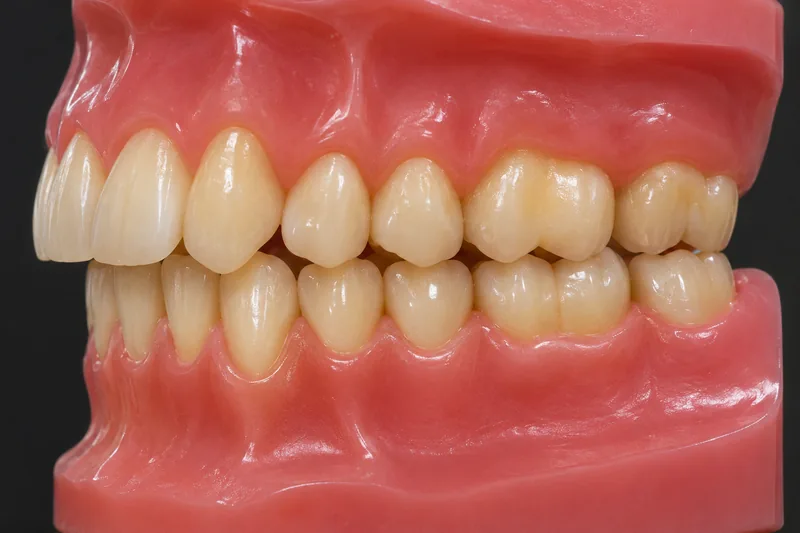
Classification concerns the relationship of the upper and lower posterior teeth. Looking only at the front teeth in a mirror is insufficient.
A distal dental relationship does not automatically mean that the lower jaw alone is too small or too far back. Several factors may contribute.
Growth, tooth inclination, overlap and function are assessed together. They determine whether and how orthodontic treatment is appropriate.
Front-to-back relationship of dental arches.
No.
Distinguish tooth positions and jaw bases.
Three steps. No audio.
Each scene can also be selected manually.

Silent educational film with German on-screen text and simplified teaching images. Not a patient case or a promised treatment outcome. The full English explanation is available below.
Classification concerns the relationship of the upper and lower posterior teeth. Looking only at the front teeth in a mirror is insufficient.
A distal dental relationship does not automatically mean that the lower jaw alone is too small or too far back. Several factors may contribute.
Growth, tooth inclination, overlap and function are assessed together. They determine whether and how orthodontic treatment is appropriate.
Both involve distal posterior relationships. Their characteristic upper-incisor appearances and inclinations differ; individual patterns vary.
No. Overjet measures horizontal incisor distance; distal occlusion describes the sagittal posterior dental relationship.
No. Dental and skeletal relationships require separate assessment.
No. Treatment and appliances follow individual findings, not the label alone.
Editorially suggested question to discuss with Dr Niusha Barahmand Pour:
Which parts of my finding concern the teeth and which concern the jaw bases?
Questions about bite relationships can be assessed through the tooth contacts and specialist orthodontic input where appropriate.
Discuss the bite relationshipAppointment selection at DoctolibBoth involve distal posterior relationships. Their characteristic upper-incisor appearances and inclinations differ; individual patterns vary.
Editorial research: . General information, not an individual diagnosis or treatment recommendation. Teaching illustrations are simplified and do not depict a patient case.