Used with aligners?
Yes, when the plan requires them.

Orthodontic elastics are small rubber bands attached to designated hooks or buttons. They apply additional forces, for example between the upper and lower jaws, and can supplement braces or aligners. Attachment points, force and wearing time are individually prescribed.
For training & practice ↓
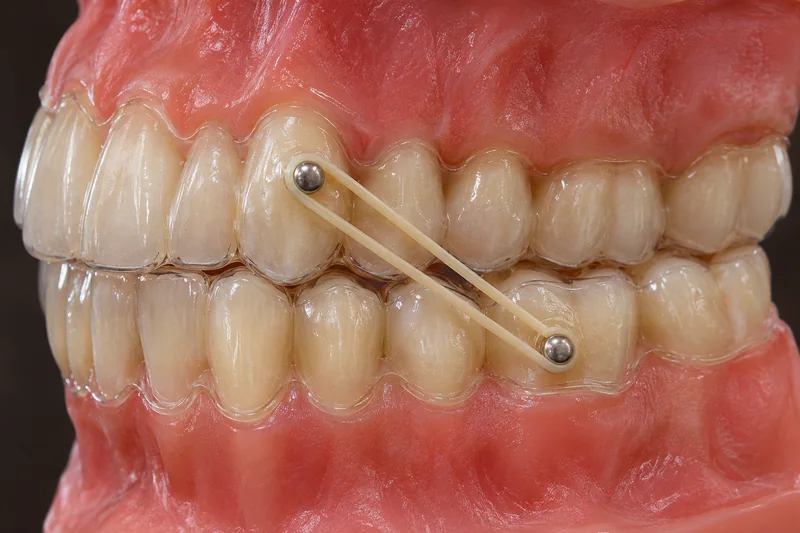
An elastic connects specified attachment points. It is not placed loose around a tooth neck; it attaches to purpose-made elements.
Different arrangements support different bite corrections. An online illustration cannot replace the personal hooking instructions.
Wearing and replacement instructions are individualized. Doubling bands or changing strength does not reliably speed treatment and can cause harm.
Yes, when the plan requires them.
No.
Do not add bands without instructions.
Three steps. No audio.
Each scene can also be selected manually.

Silent educational film with German on-screen text and simplified teaching images. Not a patient case or a promised treatment outcome. The full English explanation is available below.
An elastic connects specified attachment points. It is not placed loose around a tooth neck; it attaches to purpose-made elements.
Different arrangements support different bite corrections. An online illustration cannot replace the personal hooking instructions.
Wearing and replacement instructions are individualized. Doubling bands or changing strength does not reliably speed treatment and can cause harm.
Elastics used for bite correction differ from small rings securing an archwire to a bracket. Aligner attachments are separate guiding or anchoring features.
No. Their use depends on the planned tooth and bite movements.
Contact the treating practice and do not invent a new arrangement. Advice on continued wear depends on the specific problem.
Discuss a known or suspected allergy before use. Latex-free options exist; the team selects an appropriate type.
Editorially suggested question to discuss with Dr Niusha Barahmand Pour:
What is the purpose of elastics in my plan, and what are my exact wearing instructions?
An aligner consultation can clarify whether additional elastics are likely to be part of the individual plan.
Discuss aligners and bite correctionAppointment selection at DoctolibElastics used for bite correction differ from small rings securing an archwire to a bracket. Aligner attachments are separate guiding or anchoring features.
Editorial research: . General information, not an individual diagnosis or treatment recommendation. Teaching illustrations are simplified and do not depict a patient case.