What is its purpose?
To support appropriate working-length determination.

Electronic measurement helps estimate the position of a fine instrument within a root canal. A circuit using very small measurement signals relies on tissue electrical properties. The result supports determination of working length and is interpreted with the other findings.
For training & practice ↓
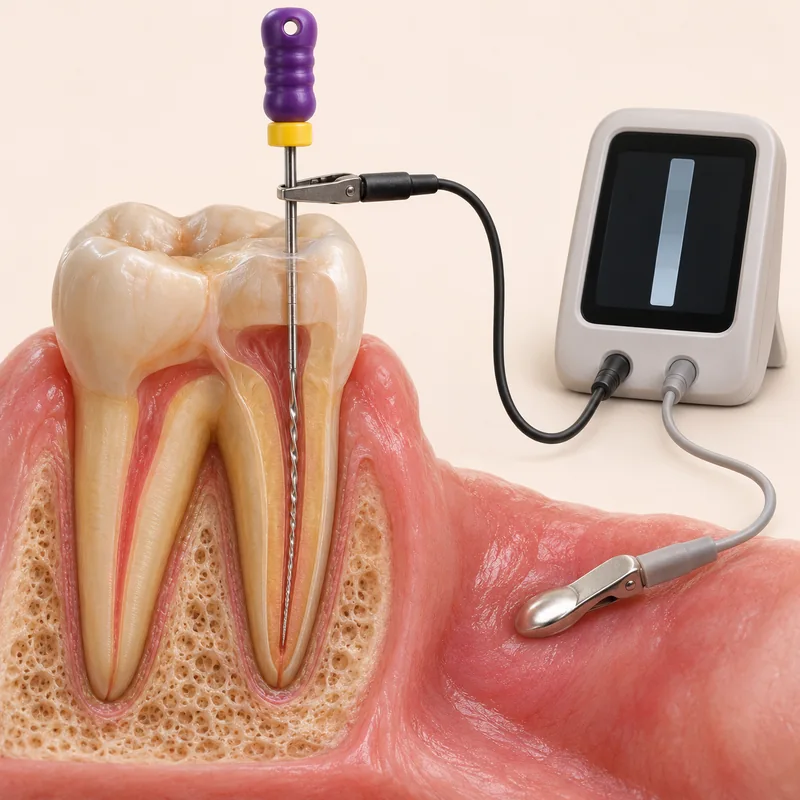
An instrument contact and another oral contact form the measuring circuit. The display guides position; it is not a photograph of the root tip.
Anatomy, measuring conditions and canal course are considered. A display reading alone is not a universal millimetre instruction.
Electronic readings and necessary radiographs complement one another. Together they inform the working endpoint for each canal.
To support appropriate working-length determination.
A measurement alone does not assess the whole tooth.
Which measurement and imaging methods the findings require.
Three steps. No audio.
Each scene can also be selected manually.

Silent educational film with German on-screen text and simplified teaching images. Not a patient case or a promised treatment outcome. The full English explanation is available below.
An instrument contact and another oral contact form the measuring circuit. The display guides position; it is not a photograph of the root tip.
Anatomy, measuring conditions and canal course are considered. A display reading alone is not a universal millimetre instruction.
Electronic readings and necessary radiographs complement one another. Together they inform the working endpoint for each canal.
Measurement provides information. Working length is the clinical working distance chosen using that and other findings.
No. It assists instrument positioning; it does not test whether the pulp is healthy.
No. Other diagnostic questions may still require imaging.
No. Clinical conditions and root anatomy affect interpretation. Implausible readings need checking.
An editorially suggested question for a discussion with Dr med dent Niusha Barahmand Pour:
How are the measurement, radiograph and root anatomy considered together?
Your plan mentions electronic measurement? Ask what question it helps answer for your tooth.
Discuss the measurement methodAppointment selection at DoctolibMeasurement provides information. Working length is the clinical working distance chosen using that and other findings.
Editorial research: . General information, not an individual diagnosis or treatment recommendation. Teaching illustrations are simplified and do not depict a patient case.