Aim?
Treat a narrow upper jaw.

Palatal expansion is an orthodontic treatment for a narrow upper jaw. A selected appliance applies controlled forces. Growth, age, bone anatomy and the bite determine the approach; adults may need different anchorage or surgical assistance.
For training & practice ↓
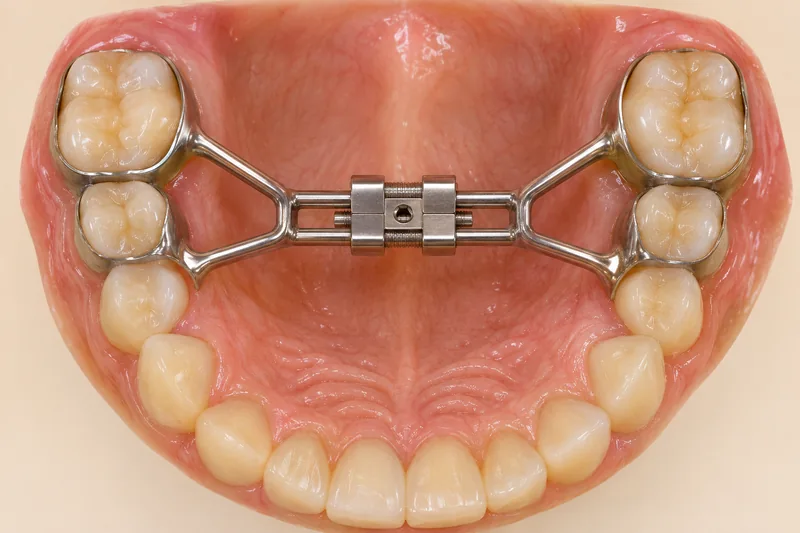
A narrow upper jaw may be associated with a posterior crossbite. Crowding alone does not establish the need for expansion.
Tooth-borne and bone-anchored appliances have different uses. Activation and review follow the individual orthodontic plan.
An active expansion phase is followed by stabilization. Its form and duration are monitored; adjusting the appliance without instructions can cause harm.
Treat a narrow upper jaw.
No.
Orthodontic assessment determines the approach.
Three steps. No audio.
Each scene can also be selected manually.

Silent educational film with German on-screen text and simplified teaching images. Not a patient case or a promised treatment outcome. The full English explanation is available below.
A narrow upper jaw may be associated with a posterior crossbite. Crowding alone does not establish the need for expansion.
Tooth-borne and bone-anchored appliances have different uses. Activation and review follow the individual orthodontic plan.
An active expansion phase is followed by stabilization. Its form and duration are monitored; adjusting the appliance without instructions can cause harm.
Teeth can move within anatomical limits. Skeletal expansion targets the upper-jaw base; these are not equivalent changes.
No. Maturity changes the conditions. Adults may need a different or combined approach.
Not automatically. Moving teeth and expanding the bony upper-jaw base are different objectives.
That cannot be promised. Breathing or sleep problems require their own medical assessment.
Editorially suggested question to discuss with Dr Niusha Barahmand Pour:
Does my finding concern tooth positions or the width of the bony jaw base?
Questions about a narrow upper jaw can be a starting point for discussing appropriate specialist assessment.
Discuss jaw width and the biteAppointment selection at DoctolibTeeth can move within anatomical limits. Skeletal expansion targets the upper-jaw base; these are not equivalent changes.
Editorial research: . General information, not an individual diagnosis or treatment recommendation. Teaching illustrations are simplified and do not depict a patient case.