Are the visible bumps on my tongue taste buds?
The bumps you can see in the mirror are papillae.

A taste bud is a microscopic cluster of sensory and supporting cells. Substances dissolved from food reach the sensory cells through a tiny opening. When we taste something sweet, sour, salty, bitter or savoury, nerves carry signals from these cells to the brain. Many taste buds sit within particular papillae on the tongue. Others are found in the soft palate and throat.
For training & practice ↓
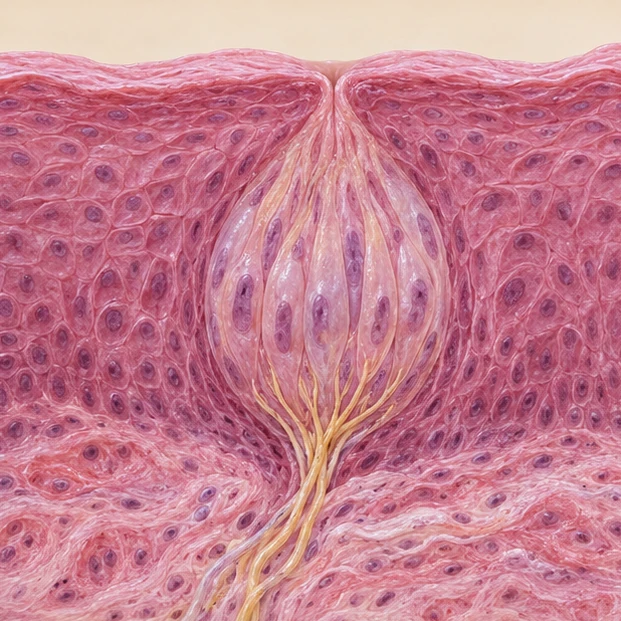
Dissolved substances reach sensory cells at a tiny pore. The enlarged model helps distinguish a taste bud from the visible tongue surface.
Papillae are visible on the tongue surface. Numerous filiform papillae serve a mechanical purpose and contain no taste buds.
An apple can still taste sweet with a blocked nose. Its distinctive flavour depends strongly on smell.
The bumps you can see in the mirror are papillae.
Sweet, sour, bitter, salty and umami can each be perceived in several regions. The familiar tongue map assigning a single taste to each area is misleading. The burning sensation from chilli belongs to a separate sensory system.
As you chew, aromas normally pass from the mouth to the nose.
Three steps. No audio.
Each scene can also be selected manually.

Silent film with English on-screen text and simplified teaching images.
Papillae are visible on the tongue surface. Numerous filiform papillae serve a mechanical purpose and contain no taste buds.
The bumps you can see in the mirror are papillae. Fungiform, foliate and circumvallate papillae can contain taste buds. Numerous filiform papillae give the tongue a rough surface and help it move food around. These papillae contain no taste buds. Tongue papillae
Sweet, sour, bitter, salty and umami can each be perceived in several regions. The familiar tongue map assigning a single taste to each area is misleading. The burning sensation from chilli belongs to a separate sensory system.
As you chew, aromas normally pass from the mouth to the nose. A blocked nose reduces this effect. An apple and a pear may still taste sweet but be harder to tell apart. A GP or ENT specialist can assess persistent changes and test smell and taste separately. Taste disturbance
A question to ask
Is my sense of smell or my perception of basic tastes more affected?
Seek GP or ENT assessment for a new persistent change in taste.
Choose an appointmentAppointment selection at DoctolibA papilla is the visible tissue structure. A taste bud contains sensory cells and opens to the surface through a taste pore. When assessing a complaint, ask separately about basic taste qualities and the aroma of familiar foods.
Editorial research: . General information, not an individual diagnosis or treatment recommendation. Teaching illustrations are simplified and do not depict a patient case.
If you turn this on, this website stores which guides you open, separately from advertising preferences. The markers expire after a fixed 30-day period from activation. The list is not sent to us by this feature. You can turn it off here and delete the markers.
Other people using the same browser profile can also see the markers. German and English versions share one marker. Expired entries are removed the next time you open a page with this feature; deleting browser data may remove them earlier. “Viewed” means opened, not read or completed.