A temporary structure?
Yes.

Hertwig’s epithelial root sheath is a temporary structure made of two epithelial cell layers during root development. It arises from the inner and outer enamel epithelia at the edge of the enamel organ and helps shape the developing root. Its interactions with neighbouring cells matter for root dentine and periodontal development. It does not remain a continuous covering around the mature tooth.
For training & practice ↓
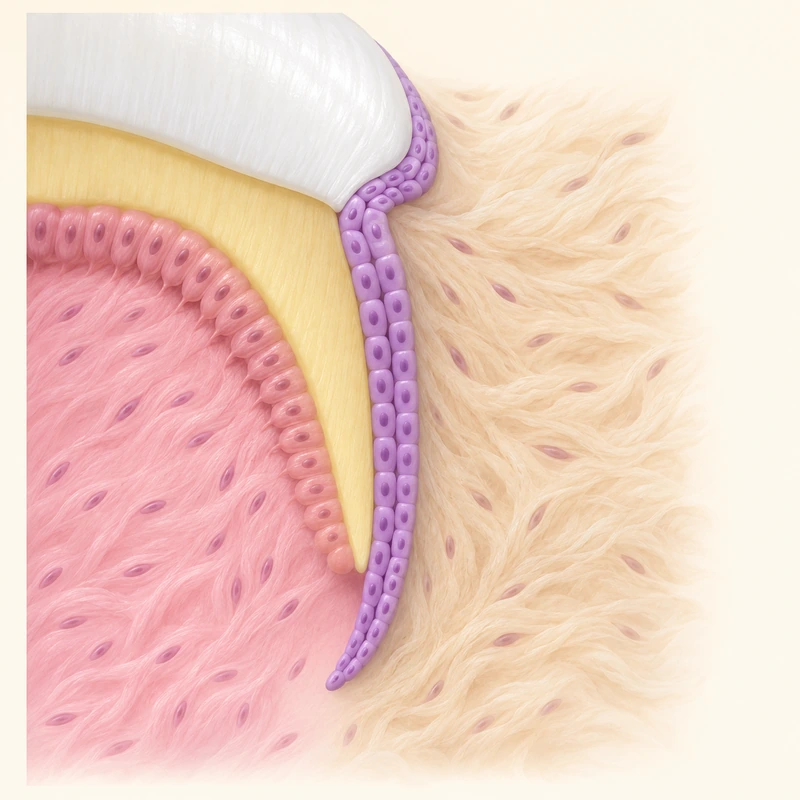
After crown formation, the epithelial layers extend into the future root region. This highly magnified diagram shows a developmental stage, not a membrane visible in the mouth.
The sheath outlines the developing root region and interacts with dentine-forming cells. It is neither the finished root dentine nor the root cementum.
As development continues, the sheath becomes interrupted and leaves groups of cells. Epithelial rests may persist in the periodontium; a continuous protective sleeve does not remain.
Yes.
Two.
No.
Three steps. No audio.
Each scene can also be selected manually.

Silent educational film with German on-screen text and simplified teaching images. Not a patient case or a promised treatment outcome. The full English explanation is available as text.
The epithelial sheath contributes to root formation during development. The mature supporting tissues include cementum, periodontal ligament and alveolar bone; they are not the same as this epithelial covering.
No. It is a temporary epithelial structure during development. Cementum is a mineralised tissue on the root surface.
Individual cell layers are not directly shown. Radiographs can show the development of mineralised tooth structures, not the detail of this microscopic tissue.
No. Findings about cell interactions help explain development. They do not establish a generally available or individually proven way to replace an entire root.
You can bring this question to your appointment:
Which aspect of root maturity matters for the treatment being considered?
An individual assessment can clarify the findings and whether referral is needed.
Arrange an assessmentAppointment selection at DoctolibThe epithelial sheath contributes to root formation during development. The mature supporting tissues include cementum, periodontal ligament and alveolar bone; they are not the same as this epithelial covering.
Editorial research: . General information, not an individual diagnosis or treatment recommendation. Teaching illustrations are simplified and do not depict a patient case.
If you turn this on, this website stores which guides you open, separately from advertising preferences. The markers expire after a fixed 30-day period from activation. The list is not sent to us by this feature. You can turn it off here and delete the markers.
Other people using the same browser profile can also see the markers. German and English versions share one marker. Expired entries are removed the next time you open a page with this feature; deleting browser data may remove them earlier. “Viewed” means opened, not read or completed.