What does it do?
Attachment, force distribution and sensing load.

The periodontal ligament is the narrow fibrous tissue between a tooth root and its socket. Its fibres connect root cementum to bone. It distributes forces and contains vessels and nerves; it is not a hard layer of the tooth.
For training & practice ↓
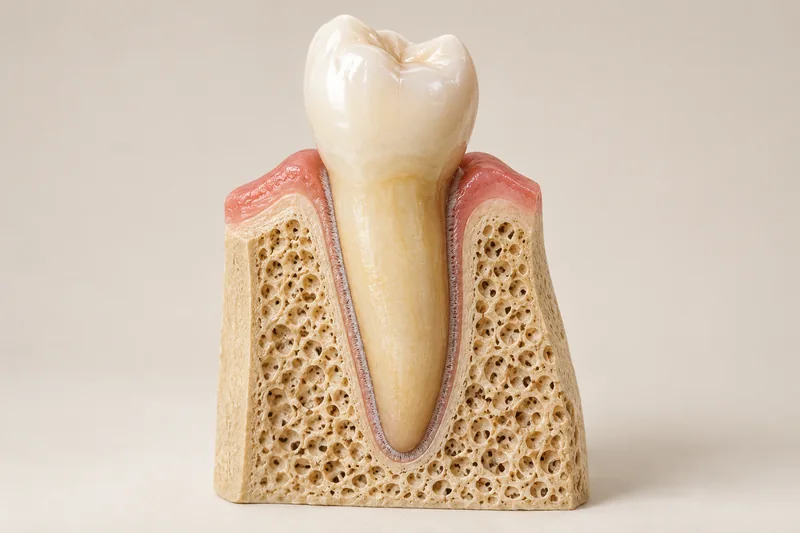
Fibres run in different directions between root and bone, allowing slight physiological movement.
Nerves help sense biting forces. A spring is only an analogy; this tissue is not a rubber band.
Pressure pain or unusual looseness has several possible causes and should be assessed. Repeatedly wiggling the tooth is not a useful self-test.
Attachment, force distribution and sensing load.
In tooth support, tooth movement and biting symptoms.
Repeatedly testing looseness yourself.
Three steps. No audio.
Each scene can also be selected manually.

Silent educational film with German on-screen text and simplified teaching images. Not a patient case or a promised treatment outcome. The full English explanation is available below.
Fibres run in different directions between root and bone, allowing slight physiological movement.
Nerves help sense biting forces. A spring is only an analogy; this tissue is not a rubber band.
Pressure pain or unusual looseness has several possible causes and should be assessed. Repeatedly wiggling the tooth is not a useful self-test.
Cementum is hard tissue covering the root. The ligament is the fibrous connection to bone.
No. Pulp is inside the tooth; the ligament lies outside the root.
A healed dental implant has a different bone attachment and no natural periodontal ligament.
No. Slight movement is physiological; unusual changes need assessment.
An editorially suggested question for a discussion with Dr med dent Niusha Barahmand Pour:
Which structure might explain pressure pain, and what needs assessment?
A tooth feels different on biting? Have the cause and its support assessed.
Discuss the symptomsAppointment selection at DoctolibCementum is hard tissue covering the root. The ligament is the fibrous connection to bone.
Editorial research: . General information, not an individual diagnosis or treatment recommendation. Teaching illustrations are simplified and do not depict a patient case.