Who is this explanation for?
People considering whitening at home who want to understand its limits.

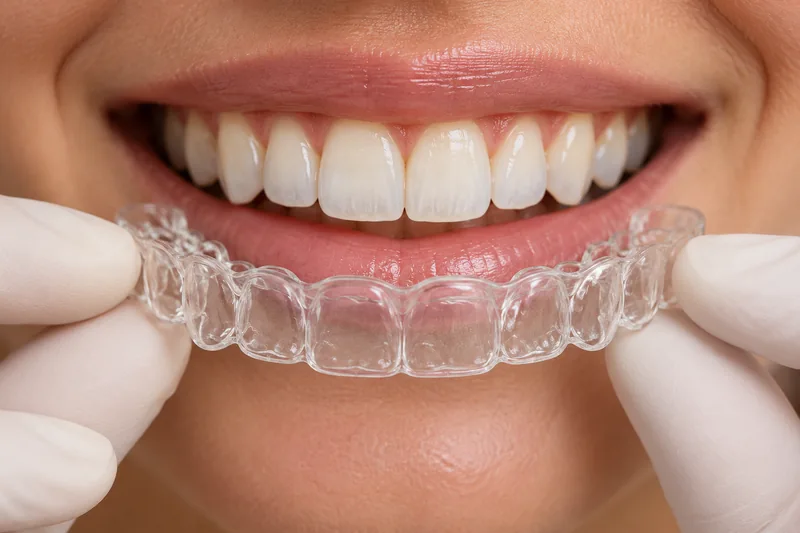
Dentist-supervised home whitening is a planned lightening of natural teeth carried out at home after examination and instruction. A custom-fitted tray containing a whitening agent is often used. The method and application depend on the individual findings.
For training & practice ↓
Not every darker area responds in the same way. Tooth colour, existing restorations and the health of teeth and gums are assessed before treatment.
The tray holds a suitable agent against the intended tooth surfaces. Amount, wearing time and duration depend on the product and findings; more or longer is not automatically better.
Natural teeth may become lighter, but fillings and crowns retain their colour. If sensitivity or gum irritation develops, pause use and discuss how to proceed.
People considering whitening at home who want to understand its limits.
Examination, shade comparison and discussion of existing restorations and possible discomfort.
Clear instructions and review of the response and tolerance.
Three steps. No audio.
Each scene can also be selected manually.

Silent educational film with German on-screen text and simplified teaching images. Not a patient case or a promised treatment outcome. The full English explanation is available below.
Not every darker area responds in the same way. Tooth colour, existing restorations and the health of teeth and gums are assessed before treatment.
The tray holds a suitable agent against the intended tooth surfaces. Amount, wearing time and duration depend on the product and findings; more or longer is not automatically better.
Natural teeth may become lighter, but fillings and crowns retain their colour. If sensitivity or gum irritation develops, pause use and discuss how to proceed.
Whitening toothpastes often mainly act on external stains. Bleaching uses chemically active whitening agents. Similar advertising words do not describe the same process.
No. Bleaching does not similarly lighten existing fillings, crowns or veneers. Differences in colour may become noticeable.
No. Follow the instructions given for the individual application. Extra gel or longer wear does not reliably improve benefit and can contribute to discomfort.
Neither a fixed duration nor a particular final shade can be promised. Starting colour, its cause and later influences matter; any repeat application needs reassessment.
An editorially suggested question for a discussion with Dr med dent Niusha Barahmand Pour:
What type of discolouration is present, and how would my existing fillings look if the teeth were whitened?
Start by finding out what causes the tooth colour and which options may fit.
Discuss tooth colour in personAppointment selection at DoctolibWhitening toothpastes often mainly act on external stains. Bleaching uses chemically active whitening agents. Similar advertising words do not describe the same process.
Editorial research: . General information, not an individual diagnosis or treatment recommendation. Teaching illustrations are simplified and do not depict a patient case.