Who may find this relevant?
People with one darker tooth that has already had root canal treatment.

Internal bleaching lightens a tooth from within its crown. It may be considered for certain discoloured teeth that have already had root canal treatment. Examination of the stain and existing root canal treatment determines whether it is appropriate.
For training & practice ↓
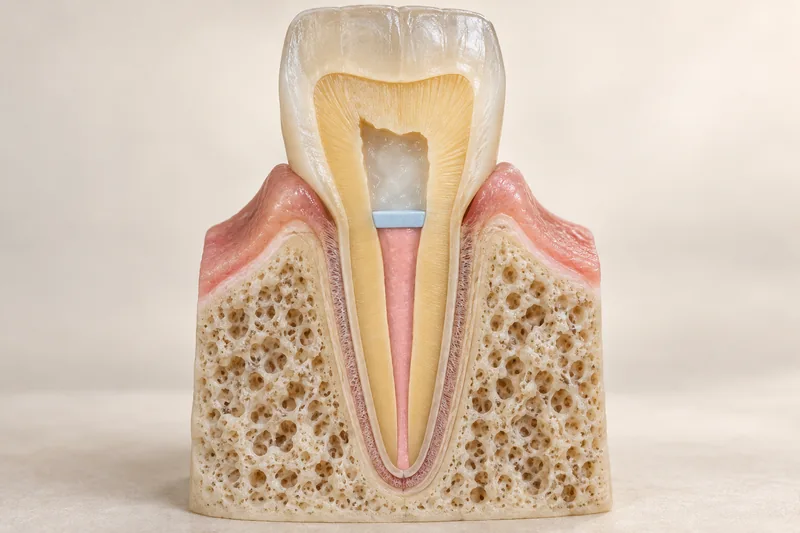
The darker colour may originate inside the tooth. Its cause, existing restoration and the condition of the tooth need assessment.
A suitable whitening agent is placed inside the crown as part of dental treatment. This is not a do-it-yourself procedure and does not mean filling the entire root canal with bleaching agent.
The colour response and tooth condition are reviewed, and the access is appropriately restored. Responses vary, and the tooth may become darker again later.
People with one darker tooth that has already had root canal treatment.
Cause, tooth condition and existing root treatment, with radiographs where indicated.
Review of the colour, restoration and tooth condition.
Three steps. No audio.
Each scene can also be selected manually.

Silent educational film with German on-screen text and simplified teaching images. Not a patient case or a promised treatment outcome. The full English explanation is available below.
The darker colour may originate inside the tooth. Its cause, existing restoration and the condition of the tooth need assessment.
A suitable whitening agent is placed inside the crown as part of dental treatment. This is not a do-it-yourself procedure and does not mean filling the entire root canal with bleaching agent.
The colour response and tooth condition are reviewed, and the access is appropriately restored. Responses vary, and the tooth may become darker again later.
Internal bleaching works inside the crown of a suitable root-treated tooth. External bleaching is applied to outer tooth surfaces. Different causes of discolouration require different assessment.
This explanation concerns teeth that already have root canal treatment. It does not imply that a root canal should be performed solely to obtain whitening.
No. Alongside an insufficient or uneven colour change, rare risks include external cervical resorption: loss of tooth tissue around the neck of the tooth. Risks and suitability need discussion beforehand.
No. Its cause and root filling need assessment. Have a dark tooth examined; do not introduce agents into a tooth yourself.
An editorially suggested question for a discussion with Dr med dent Niusha Barahmand Pour:
What caused this tooth to darken, and which risks matter with its existing root canal treatment?
One darker tooth can be examined specifically before deciding on a change.
Have a dark tooth assessedAppointment selection at DoctolibInternal bleaching works inside the crown of a suitable root-treated tooth. External bleaching is applied to outer tooth surfaces. Different causes of discolouration require different assessment.
Editorial research: . General information, not an individual diagnosis or treatment recommendation. Teaching illustrations are simplified and do not depict a patient case.