Function?
Control chewing and jaw movement.

Several muscles work together to control chewing and mandibular movement. The main groups are masseter, temporalis and the medial and lateral pterygoids. Facial pain does not always originate in a tooth.
For training & practice ↓
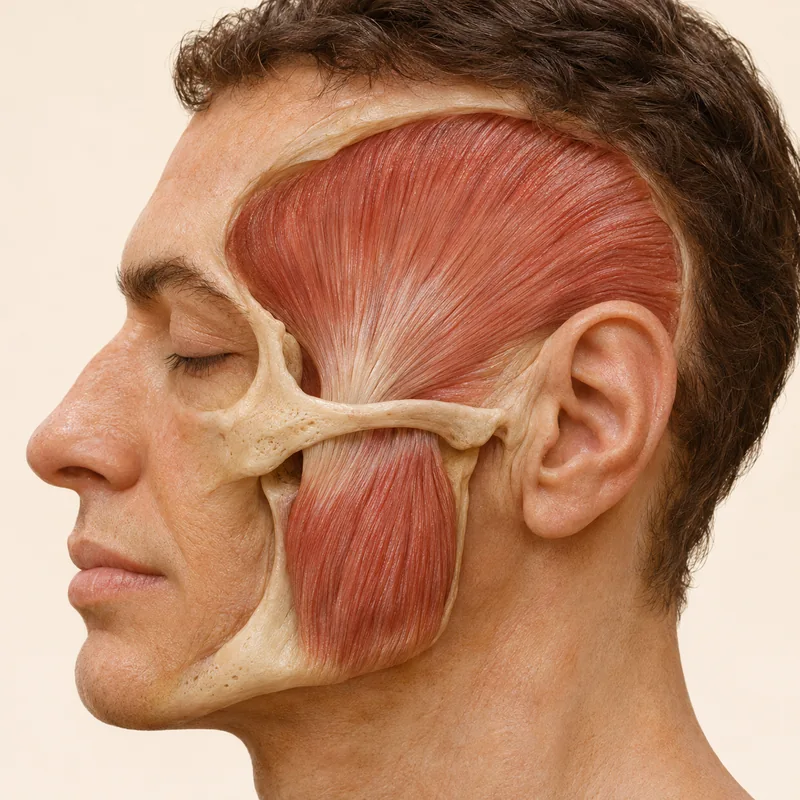
Muscles at the cheek, temple and deeper in the face coordinate movement with both jaw joints.
Prolonged clenching and other loads may accompany symptoms. Tension alone cannot establish their cause.
Teeth, joints, muscles and other possible sources are assessed. This does not automatically lead to a splint or injection.
Control chewing and jaw movement.
Assess the source and contributing factors.
Record the pattern and relevant activities.
Three steps. No audio.
Each scene can also be selected manually.

Silent educational film with German on-screen text and simplified teaching images. Not a patient case or a promised treatment outcome. The full English explanation is available below.
Muscles at the cheek, temple and deeper in the face coordinate movement with both jaw joints.
Prolonged clenching and other loads may accompany symptoms. Tension alone cannot establish their cause.
Teeth, joints, muscles and other possible sources are assessed. This does not automatically lead to a splint or injection.
Muscle pain may be referred elsewhere. The perceived location is not always its source.
No. Masseter lies over the outer jaw angle; other cheek muscles perform different tasks.
No. There are different causes; persistent symptoms need assessment.
Note when pain occurs and whether chewing, yawning or clenching changes it. Avoid repeatedly pressing hard on painful areas.
Editorially suggested question to discuss with Dr Niusha Barahmand Pour:
Does my pain arise from a tooth, a muscle or the joint?
Recurring pain on chewing deserves a focused assessment.
Discuss pain on chewingAppointment selection at DoctolibMuscle pain may be referred elsewhere. The perceived location is not always its source.
Editorial research: . General information, not an individual diagnosis or treatment recommendation. Teaching illustrations are simplified and do not depict a patient case.