When to discuss it?
Persistent pain or restricted opening.

Temporomandibular joint osteoarthritis involves degenerative changes in the joint connecting the lower jaw to the skull. Joint surfaces and bone may change, but sounds or an imaging finding alone do not establish how severe symptoms are.
For training & practice ↓
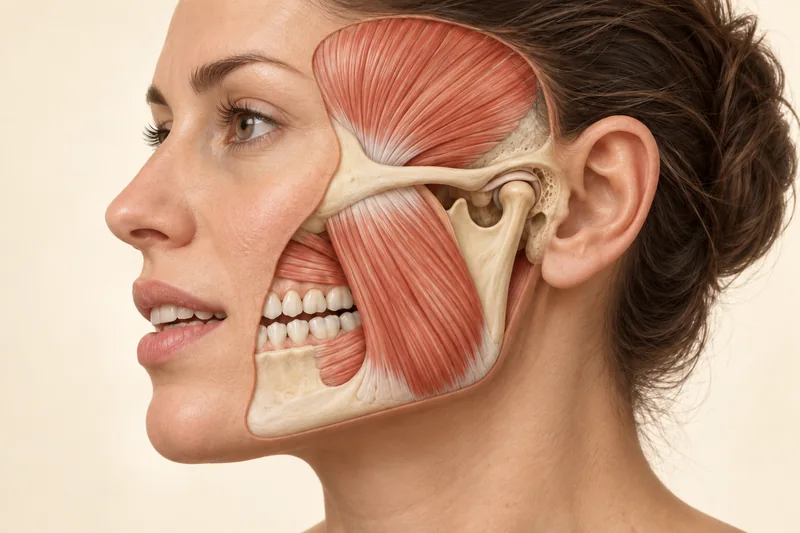
The jaw condyle, joint surface and intervening disc work together during opening. Pain can also originate in the chewing muscles.
Assessment considers movement, pain and function. Imaging is selected when it can answer a specific diagnostic question.
Education and reversible approaches are often considered first. Further steps depend on diagnosis, progress and functional limitation.
Persistent pain or restricted opening.
History, clinical examination and targeted additional tests.
DIY bite alteration or forced opening.
Three steps. No audio.
Each scene can also be selected manually.

Silent educational film with German on-screen text and simplified teaching images. Not a patient case or a promised treatment outcome. The full English explanation is available below.
The jaw condyle, joint surface and intervening disc work together during opening. Pain can also originate in the chewing muscles.
Assessment considers movement, pain and function. Imaging is selected when it can answer a specific diagnostic question.
Education and reversible approaches are often considered first. Further steps depend on diagnosis, progress and functional limitation.
TMD is an umbrella term for jaw-system disorders. Osteoarthritis concerns the joint and is not synonymous with muscle pain.
No. Clicking has different causes and may occur without disease needing treatment.
No. The examination and clinical question determine whether imaging is justified and which type is appropriate.
The word osteoarthritis does not automatically mean surgery. Findings, symptoms and suitable conservative options are assessed first.
Editorially suggested question to discuss with Dr Niusha Barahmand Pour:
Which findings explain my symptoms, and which reversible approach is suitable?
Persistent jaw-joint symptoms deserve assessment.
Discuss jaw symptomsAppointment selection at DoctolibTMD is an umbrella term for jaw-system disorders. Osteoarthritis concerns the joint and is not synonymous with muscle pain.
Editorial research: . General information, not an individual diagnosis or treatment recommendation. Teaching illustrations are simplified and do not depict a patient case.