What may decrease?
Bone volume.

Atrophy means a reduction in tissue. After tooth loss, the tooth-bearing ridge can remodel and lose width or height. The extent and course vary and cannot be judged from a mirror alone.
For training & practice ↓
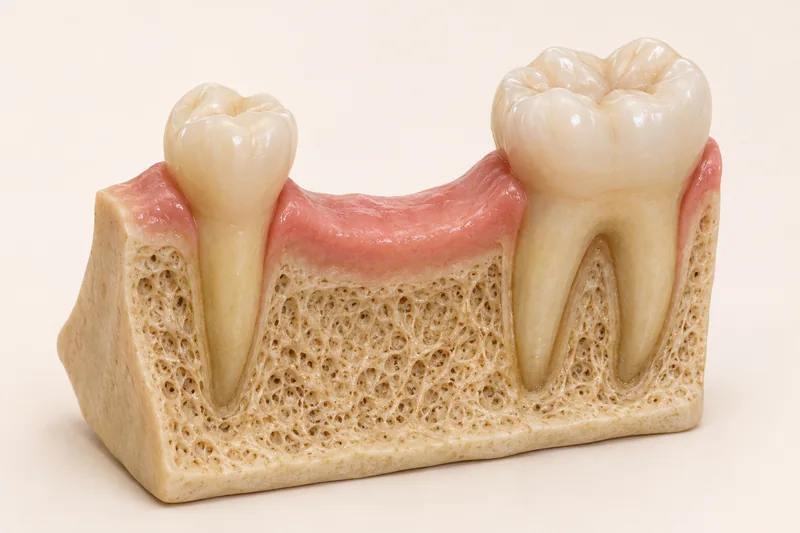
The former root region does not remain unchanged. Denture fit may change as well.
Restorative planning considers ridge shape, tissues and appropriate imaging when needed.
Bone volume is one planning factor. Denture adjustment, different designs or augmentation may be considered individually.
The former root region does not remain unchanged. Denture fit may change as well.
Restorative planning considers ridge shape, tissues and appropriate imaging when needed.
Bone volume is one planning factor. Denture adjustment, different designs or augmentation may be considered individually.
Bone volume.
Examination and targeted investigation.
No.
Three steps. No audio.
Each scene can also be selected manually.

Silent educational film with German on-screen text and simplified teaching images. Not a patient case or a promised treatment outcome. The full English explanation is available as text.
Tissue loss describes a finding; it does not establish an inflammatory cause by itself.
No. Remodelling after tooth loss differs from inflammatory loss around remaining teeth.
No. It depends on the intended restoration and clinical circumstances.
No. Changes can also occur around implants, so follow-up remains important.
Editorially suggested question to discuss with Dr Niusha Barahmand Pour:
How does the available bone affect my restoration options?
Changing denture fit or questions about bone volume can be assessed.
Discuss restorative planningAppointment selection at DoctolibTissue loss describes a finding; it does not establish an inflammatory cause by itself.
Editorial research: . General information, not an individual diagnosis or treatment recommendation. Teaching illustrations are simplified and do not depict a patient case.