What does the letter E mean, for example?
In KIG, E refers to contact-point displacement or crowding. Classification depends on the defined clinical criteria; a crowded-looking arrangement is not enough to grade it yourself.

Kieferorthopädische Indikationsgruppen, or KIG, is Germany’s classification of tooth and jaw misalignments by finding type and five severity grades. It helps assess whether the criteria for orthodontic treatment under statutory health insurance are met. The classification alone does not determine which treatment or appliance is suitable.
For training & practice ↓
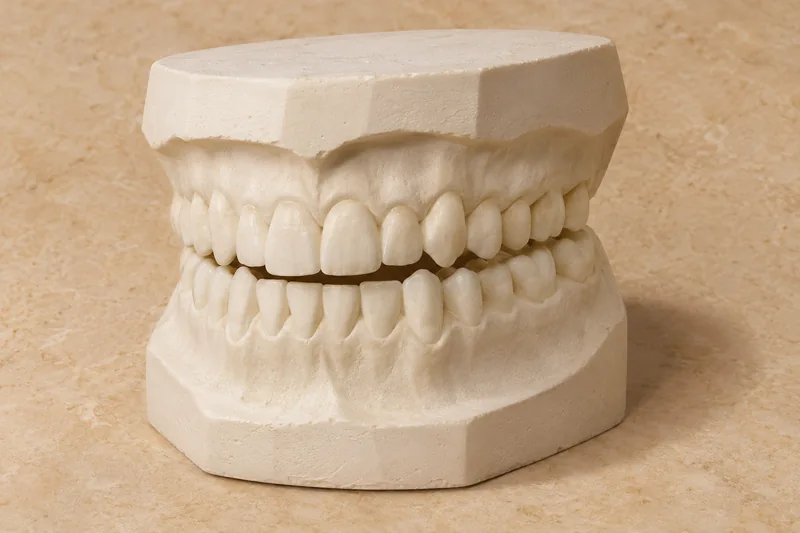
Crowding and changes in the bite are assessed clinically. Appearance alone is not enough for a reliable KIG classification. This teaching model illustrates a tooth arrangement, without assigning it a KIG grade.
The letter identifies the finding group; the number indicates one of five severity grades. The finding with the greatest treatment need is decisive. Several smaller deviations are not simply added together to make a higher grade.
Grade 3 or above can meet the KIG threshold for statutory-insurance treatment. Other eligibility requirements still need assessment. Treatment is planned from the individual findings: the number alone determines neither the appliance nor the course of care.
In KIG, E refers to contact-point displacement or crowding. Classification depends on the defined clinical criteria; a crowded-looking arrangement is not enough to grade it yourself.
A photo may prompt a question, but it does not replace clinical examination and professional classification. The illustration here therefore provides no individual KIG assessment.
The guideline places classification immediately before the planned start of treatment. An earlier assessment may therefore no longer describe the later situation.
The guideline describes initial classification as a clinical assessment that generally does not require additional diagnostic services. Further investigations may be needed individually for subsequent treatment planning.
Ask which finding is present, which group and grade it belongs to, what treatment options exist and which services are covered. The explanation should relate to the individual findings rather than simply provide a number.
Three steps. No audio.
Each scene can also be selected manually.

Silent educational film with German on-screen text and simplified teaching images. Not a patient case or a promised treatment outcome. The full English explanation is available as text.
The classification describes a finding to help categorise treatment need. It is neither a success score nor a recommendation for fixed brackets, aligners or another appliance. Appropriate treatment requires individual examination and planning.
No. These grades do not meet the KIG threshold for orthodontic care funded by German statutory health insurance. Whether treatment is appropriate for an individual is a separate clinical question. A cosmetic preference alone does not establish entitlement to this statutory orthodontic care.
No. Grades 3 to 5 meet the required severity threshold, but are not a blanket funding promise for every method or requested additional service. The findings, other eligibility criteria and treatment plan need assessment. Before treatment starts, it should be clear which services belong to statutory care and which involve separate agreements.
Orthodontic treatment started at age 18 or later is generally not part of routine German statutory-insurance coverage. An exception concerns severe jaw anomalies requiring combined jaw surgery and orthodontic treatment. A high KIG grade alone is not sufficient; the requirements must be assessed individually.
Editorially suggested question for a discussion with Dr. med. dent. Niusha Barahmand Pour:
How should my tooth alignment and function be assessed, and what further professional assessment would be appropriate?
Have a question about tooth alignment or a classification you have received? A discussion can help clarify the appropriate examination or professional point of contact.
Discuss tooth alignmentAppointment selection at DoctolibKIG uses finding groups and grades, rather than a total score made by adding arbitrary individual findings. The highest relevant classification and the other guideline criteria must be distinguished from subsequent individual treatment planning.
Editorial research: . General information, not an individual diagnosis or treatment recommendation. Teaching illustrations are simplified and do not depict a patient case.