Typical site?
The middle of the posterior tongue surface.

Median rhomboid glossitis describes a localised reddish, often smooth area in the midline of the posterior tongue surface. The usual thread-like papillae are missing there. It is commonly associated with Candida yeast and often causes no symptoms. The shape of a red tongue patch alone does not establish its diagnosis.
For training & practice ↓
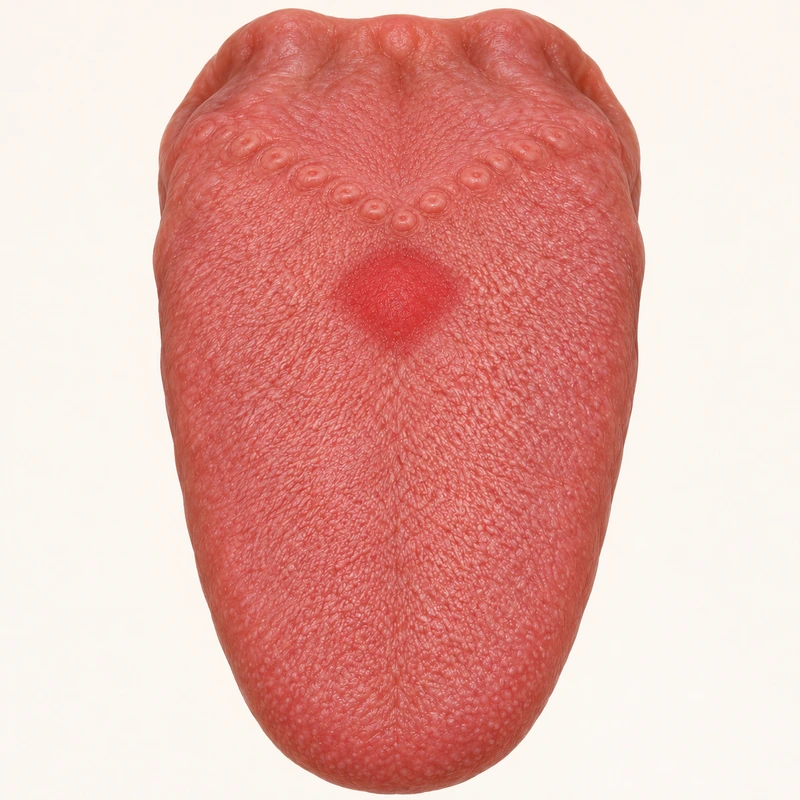
The localised patch typically lies in the midline of the posterior tongue. Loss of the usual thread-like papillae makes it look smoother and redder than the surrounding surface.
Many people have no symptoms; others notice burning with particular foods. Examination and the course of the lesion help distinguish other causes of red tongue changes.
A confirmed, symptom-free lesion often needs no treatment. Antifungal treatment may help symptomatic cases. Atypical or unresponsive areas need further assessment.
The middle of the posterior tongue surface.
No. It is often symptom-free.
No. Other red lesions need to be considered.
Three steps. No audio.
Each scene can also be selected manually.

Silent educational film with German on-screen text and simplified teaching images. Not a patient case or a promised treatment outcome. The full English explanation is available as text.
Atrophic glossitis describes loss of tongue papillae with various causes and distributions. Median rhomboid glossitis is a particular localised pattern, not a synonym for every smooth tongue.
No. The smooth areas of geographic tongue may change their position and shape. Median rhomboid glossitis typically has a localised central position towards the back of the tongue.
No. That depends on the diagnosis and symptoms. Candida is a common association, but a red patch or a photograph does not justify self-directed antifungal treatment.
If a lesion is atypical, its diagnosis remains uncertain or suitable treatment does not produce the expected course, a biopsy can help exclude other conditions.
Yes. Recurrence is possible even after successful treatment. Follow-up depends on symptoms and findings; permanent disappearance cannot be guaranteed.
You can bring this question to your appointment:
Does this fit the typical pattern, and would observation, fungal tests or a biopsy be appropriate?
An individual examination can clarify the findings and suitable next steps.
Arrange an assessmentAppointment selection at DoctolibAtrophic glossitis describes loss of tongue papillae with various causes and distributions. Median rhomboid glossitis is a particular localised pattern, not a synonym for every smooth tongue.
Editorial research: . General information, not an individual diagnosis or treatment recommendation. Teaching illustrations are simplified and do not depict a patient case.
If you turn this on, this website stores which guides you open, separately from advertising preferences. The markers expire after a fixed 30-day period from activation. The list is not sent to us by this feature. You can turn it off here and delete the markers.
Other people using the same browser profile can also see the markers. German and English versions share one marker. Expired entries are removed the next time you open a page with this feature; deleting browser data may remove them earlier. “Viewed” means opened, not read or completed.