Are these already teeth?
A small keratin-filled cyst differs from an erupted tooth.

Small whitish bumps on the palate or toothless gum ridges may be harmless developmental cysts. They contain keratin, usually cause no symptoms and generally disappear during the first months of life.
For training & practice ↓
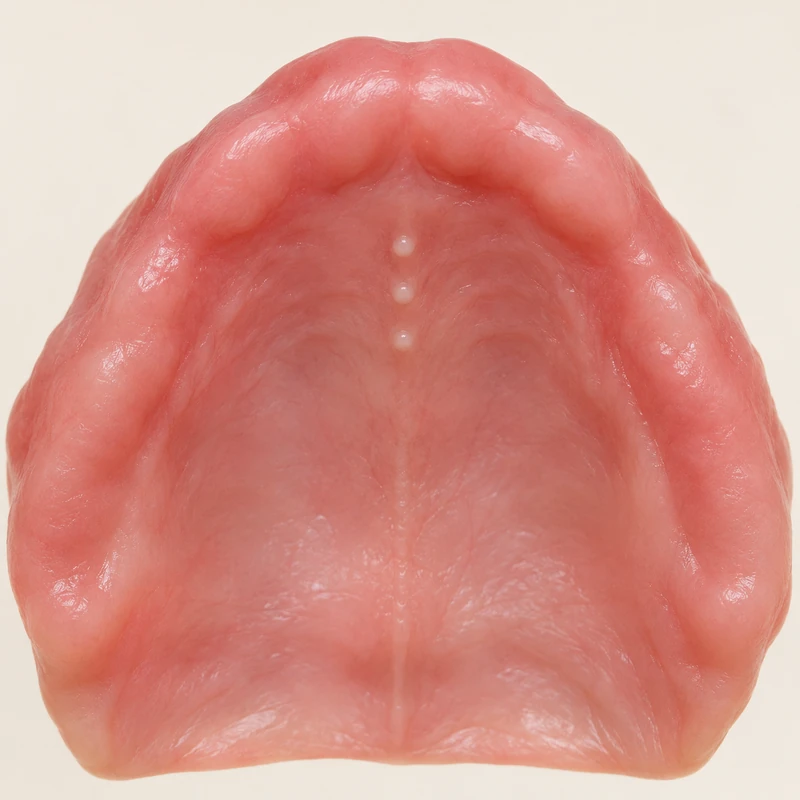
Small smooth whitish nodules along the centre line of the palate are called Epstein pearls. They arise from trapped remnants of epithelial tissue.
Dental lamina cysts can occur on the crest of a toothless gum ridge. Assessment considers the site, appearance and whether the baby feeds normally.
Typical cysts need no treatment. Show unexplained bumps to the baby’s clinician. Poor feeding or an enlarging swelling needs prompt assessment.
A small keratin-filled cyst differs from an erupted tooth.
Other white changes can look similar.
Often within the first three months of life.
Three steps. No audio.
Each scene can also be selected manually.

Silent film with English on-screen text and simplified teaching images.
This lies over a tooth about to emerge. Newborn inclusion cysts can occur without an erupting tooth.
No. Do not squeeze, puncture or scrape the area. Typical cysts resolve on their own.
A paediatric clinician assesses distribution and appearance. A photo or rubbing at home cannot reliably distinguish them.
A large, rapidly growing or bleeding lesion, or feeding problems, need prompt paediatric assessment. Call 112 in Germany for breathing difficulty.
Discussing the finding with your baby’s clinician
Are the location and course typical of inclusion cysts?
Show an uncertain finding to your baby’s clinician. Poor feeding in a newborn warrants same-day medical assessment.
Choose an appointmentAppointment selection at DoctolibSmall smooth nodules in an otherwise well baby are typical. Assessment of a new lesion depends on examination.
Editorial research: . General information, not an individual diagnosis or treatment recommendation. Teaching illustrations are simplified and do not depict a patient case.
If you turn this on, this website stores which guides you open, separately from advertising preferences. The markers expire after a fixed 30-day period from activation. The list is not sent to us by this feature. You can turn it off here and delete the markers.
Other people using the same browser profile can also see the markers. German and English versions share one marker. Expired entries are removed the next time you open a page with this feature; deleting browser data may remove them earlier. “Viewed” means opened, not read or completed.