Where is one bony attachment?
On the front of the condylar neck.

The lateral pterygoid is a deep chewing muscle with attachments around the condylar neck and jaw joint. It contributes to forward translation during protrusion and mouth opening, as well as side-to-side movements.
For training & practice ↓
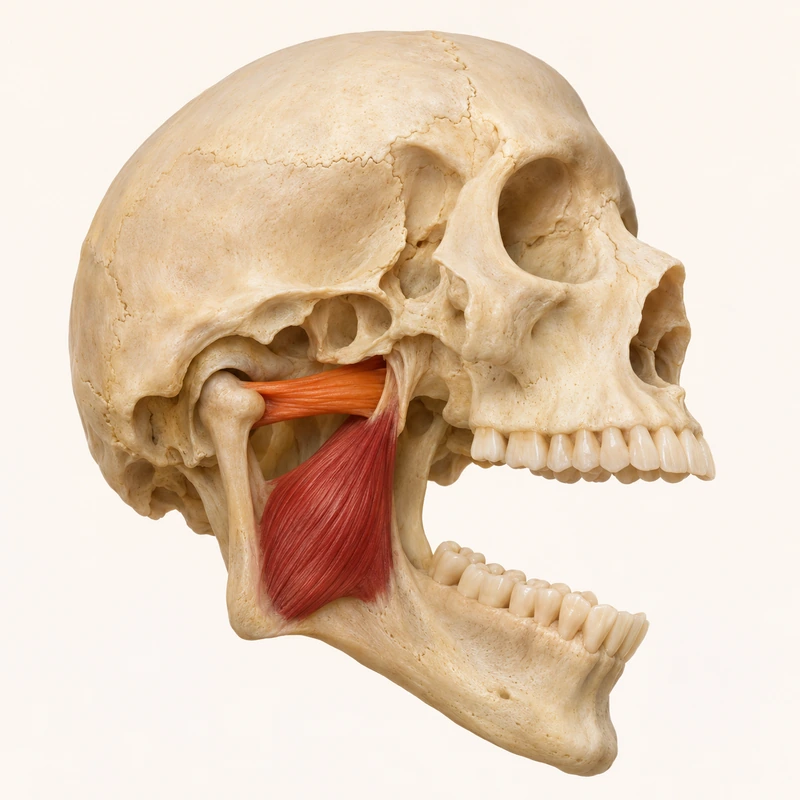
One attachment lies on the front of the condylar neck. This brings muscular force close to the moving part of the jaw joint.
As the lower jaw protrudes, the condyles glide forwards. Both lateral pterygoids contribute to this movement.
Unequal activity on the two sides can contribute to lateral motion. Opening, closing and grinding involve coordinated motion at both joints.
On the front of the condylar neck.
Mandibular protrusion.
A lateral excursion of the mandible.
Three steps. No audio.
Each scene can also be selected manually.

Silent educational film with German on-screen text and simplified teaching images. Not a patient case or a promised treatment outcome. The full English explanation is available as text.
The masseter lies more superficially on the ramus and elevates the jaw. The lateral pterygoid lies deeper, with attachments higher up near the joint.
One attachment lies on the front of the condylar neck. This brings muscular force close to the moving part of the jaw joint.
As the lower jaw protrudes, the condyles glide forwards. Both lateral pterygoids contribute to this movement.
Unequal activity on the two sides can contribute to lateral motion. Opening, closing and grinding involve coordinated motion at both joints.
Several muscles contribute to mouth opening. Forward translation of the condyle is one component.
The masseter lies more superficially on the ramus and elevates the jaw. The lateral pterygoid lies deeper, with attachments higher up near the joint.
A question you could ask
How do gliding and rotation at the joint contribute to my mouth opening?
If mouth opening feels limited, describe the movement during which you notice the restriction.
Discuss at a dental appointmentAppointment selection at DoctolibThe masseter lies more superficially on the ramus and elevates the jaw. The lateral pterygoid lies deeper, with attachments higher up near the joint.
Editorial research: . General information, not an individual diagnosis or treatment recommendation. Teaching illustrations are simplified and do not depict a patient case.
If you turn this on, this website stores which guides you open, separately from advertising preferences. The markers expire after a fixed 30-day period from activation. The list is not sent to us by this feature. You can turn it off here and delete the markers.
Other people using the same browser profile can also see the markers. German and English versions share one marker. Expired entries are removed the next time you open a page with this feature; deleting browser data may remove them earlier. “Viewed” means opened, not read or completed.