How many?
One on each side.

The mandibular condyle is the joint head at the posterior upper process of the lower jaw. On each side it forms part of the temporomandibular joint together with the temporal bone and the intervening articular disc. Mouth opening involves both rotation and gliding. The condyle is a bony structure, not the disc or the whole joint.
For training & practice ↓
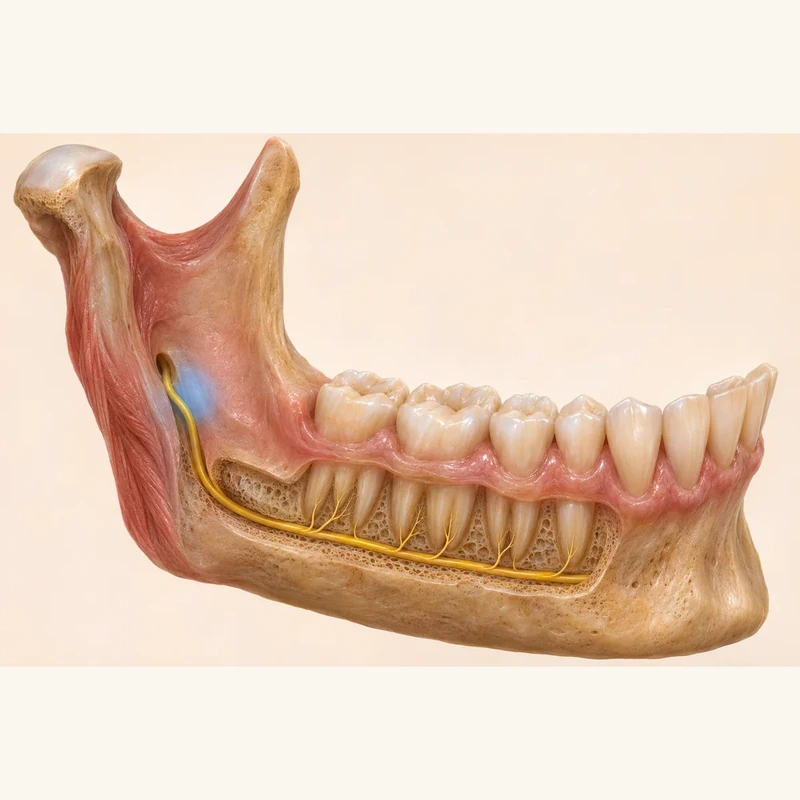
The upper mandibular ramus has two processes. The posterior one carries the condyle; the anterior one mainly provides muscle attachment.
The disc lies between the condyle and temporal bone. Bone and disc are different parts of the same movable connection.
Opening combines rotation and gliding. Pain or restricted opening is assessed alongside muscles and other findings.
One on each side.
No; gliding also occurs.
No.
Three steps. No audio.
Each scene can also be selected manually.

Silent educational film with German on-screen text and simplified teaching images. Not a patient case or a promised treatment outcome. The full English explanation is available as text.
The condyle is the mandibular joint head. The whole joint also includes the skull-side structures, disc, capsule and other tissues.
The mandible has a right and a left condyle. They belong to the two jaw joints of the same lower jaw.
No. The condyle is bone; the disc is fibrous tissue between the joint surfaces.
No. Rotation and gliding work together during opening. The movement is more complex than a simple door hinge.
No. Painless joint sounds alone are common and usually need no treatment. Pain, locking or restricted movement should be assessed.
No. History and clinical examination come first. Imaging is selected individually to answer a specific clinical question.
You can bring this question to your appointment:
Does my finding concern the condyle, the disc or another structure?
A dental examination can clarify how this relates to your findings and treatment planning.
Discuss your dental findingsAppointment selection at DoctolibThe condyle is the mandibular joint head. The whole joint also includes the skull-side structures, disc, capsule and other tissues.
Editorial research: . General information, not an individual diagnosis or treatment recommendation. Teaching illustrations are simplified and do not depict a patient case.
If you turn this on, this website stores which guides you open, separately from advertising preferences. The markers expire after a fixed 30-day period from activation. The list is not sent to us by this feature. You can turn it off here and delete the markers.
Other people using the same browser profile can also see the markers. German and English versions share one marker. Expired entries are removed the next time you open a page with this feature; deleting browser data may remove them earlier. “Viewed” means opened, not read or completed.