Location?
Side of the skull.

Temporalis is a fan-shaped chewing muscle at the temple. It attaches to the mandible and helps close the mouth. Its posterior fibres also help move the mandible backwards.
For training & practice ↓
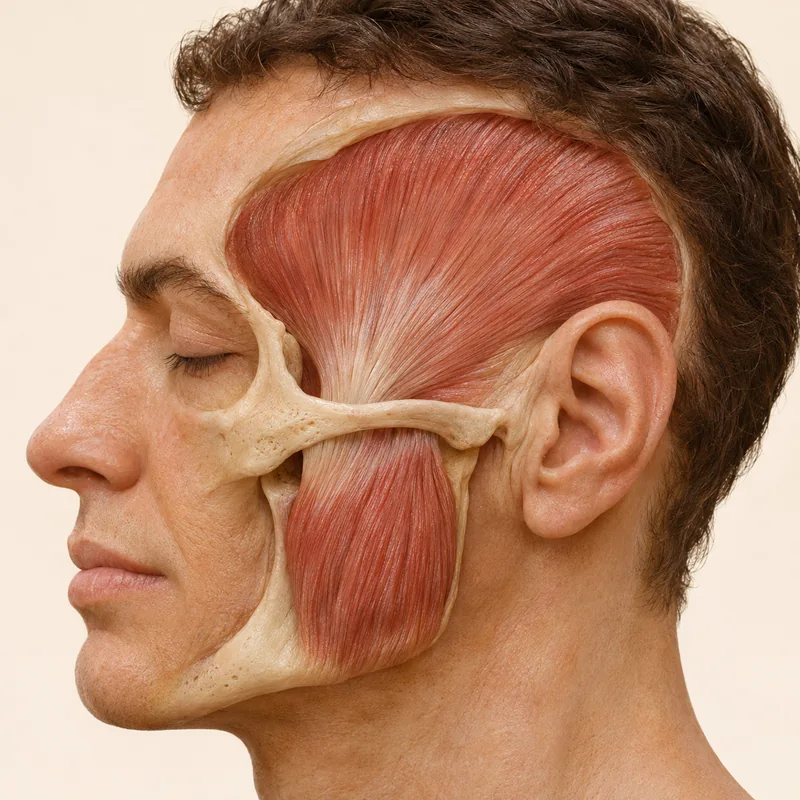
Its tendon passes beneath the cheekbone arch to reach the mandible.
It coordinates with other chewing muscles. No single muscle accounts for every jaw movement.
Temple pain has many possible causes. Location alone does not establish bruxism or TMD.
Side of the skull.
Helps close and retrude the jaw.
No; assessment is needed.
Three steps. No audio.
Each scene can also be selected manually.

Silent educational film with German on-screen text and simplified teaching images. Not a patient case or a promised treatment outcome. The full English explanation is available below.
Its tendon passes beneath the cheekbone arch to reach the mandible.
It coordinates with other chewing muscles. No single muscle accounts for every jaw movement.
Temple pain has many possible causes. Location alone does not establish bruxism or TMD.
Not all temple pain originates in temporalis.
No. Masseter lies over the outer jaw angle; temporalis lies at the temple.
Yes. Assessment distinguishes muscle, joint and other sources.
Record onset and whether chewing or clenching changes the pain. A symptom diary is not a diagnosis.
Editorially suggested question to discuss with Dr Niusha Barahmand Pour:
Could these symptoms arise from the chewing muscles?
Temple and jaw symptoms can be discussed together.
Arrange symptom assessmentAppointment selection at DoctolibNot all temple pain originates in temporalis.
Editorial research: . General information, not an individual diagnosis or treatment recommendation. Teaching illustrations are simplified and do not depict a patient case.