Where is it?
On the outer side of the ascending mandible and jaw angle.

The masseter is a strong chewing muscle on the outside of the lower jaw. It runs from the cheekbone arch to the ascending ramus and angle of the mandible and helps close the mouth. It can often be felt when the teeth are clenched. Tenderness or tension alone does not prove tooth grinding or a particular temporomandibular disorder.
For training & practice ↓
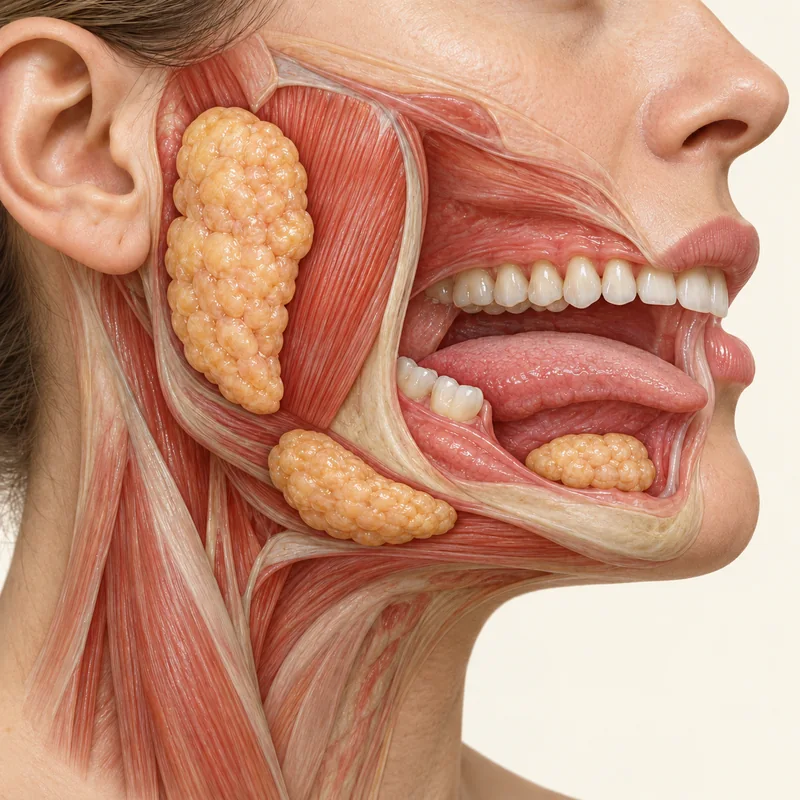
The muscle lies at the side of the cheek and jaw angle. It differs from the jaw joint in front of the ear.
Together with other muscles, it raises the mandible. Chewing coordinates muscles and joints; the masseter does not act alone.
Location, progression and triggers help assess symptoms. Teeth and other structures can also cause pain. Feeling a muscle does not establish a treatment indication.
On the outer side of the ascending mandible and jaw angle.
Moves the lower jaw with other chewing muscles, mainly raising it.
Whether symptoms may arise from muscle, joint, tooth or another cause.
Three steps. No audio.
Each scene can also be selected manually.

Silent educational film with German on-screen text and simplified teaching images. Not a patient case or a promised treatment outcome. The full English explanation is available below.
The muscle lies at the side of the cheek and jaw angle. It differs from the jaw joint in front of the ear.
Together with other muscles, it raises the mandible. Chewing coordinates muscles and joints; the masseter does not act alone.
Location, progression and triggers help assess symptoms. Teeth and other structures can also cause pain. Feeling a muscle does not establish a treatment indication.
The masseter is muscle tissue; the jaw joint is the moving connection between the mandible and skull.
No. A normal muscle tightens during biting. New pain, an unusual one-sided change or restricted mouth opening should be assessed.
No. The muscle moves the lower jaw. The joint connects it to the skull and sits higher up in front of the ear.
No. A single observation is insufficient. Symptoms, history and clinical findings are considered together.
An editorially suggested question for a conversation with Dr. med. dent. Niusha Barahmand Pour:
Which findings suggest a muscle, joint or tooth source for my symptoms?
Understanding the cause helps guide care for recurring jaw symptoms.
Discuss jaw symptomsAppointment selection at DoctolibThe masseter is muscle tissue; the jaw joint is the moving connection between the mandible and skull.
Editorial research: . General information, not an individual diagnosis or treatment recommendation. Teaching illustrations are simplified and do not depict a patient case.