Can it be painless?
Yes. Absence of pain does not rule out an odontoma or effects on a neighbouring tooth.

An odontoma is a benign, malformed collection of the tissues that normally form teeth. It is often classified as a hamartoma: the tissues are present but arranged differently from those in a regular tooth. An odontoma may form small tooth-like structures or an irregular mass of dental hard tissue. It is not cancer, but it can interfere with tooth eruption. A suspected odontoma on an X-ray needs professional assessment.
For training & practice ↓
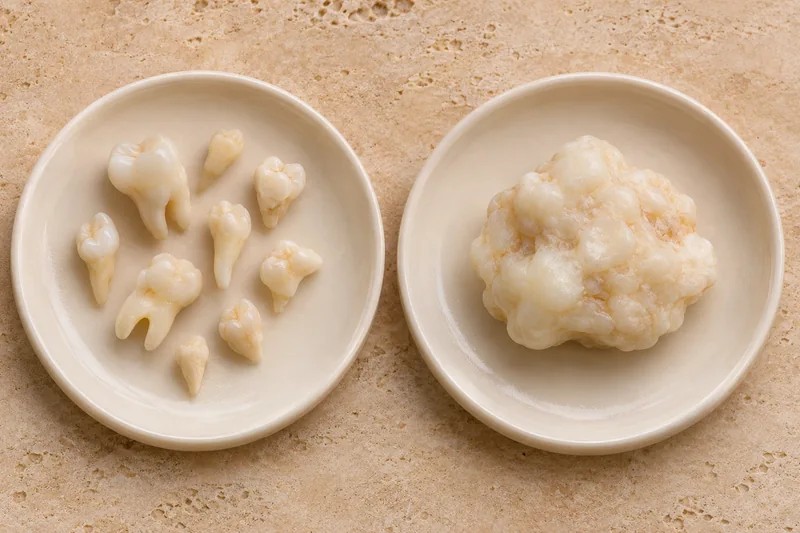
In a compound odontoma, dental tissues form several small tooth-like structures. The teaching model illustrates this arrangement; the number and shape are not criteria for self-diagnosis.
In a complex odontoma, dental tissues form an irregular mass without recognisable individual tooth shapes. The two names describe the arrangement, not two cancer stages.
An odontoma may be found incidentally or when a tooth fails to erupt. Examination and appropriate imaging establish its location and possible effects. Tissue removed during surgery is usually examined microscopically to confirm the diagnosis.
Yes. Absence of pain does not rule out an odontoma or effects on a neighbouring tooth.
No. It is often discovered in young people, but can also be found in adults.
Ask whether this is a suspected or confirmed diagnosis, which teeth are affected, and what further assessment or referral is recommended.
Three steps. No audio.
Each scene can also be selected manually.

Silent educational film with German on-screen text and simplified teaching images. Not a patient case or a promised treatment outcome. The full English explanation is available as text.
A supernumerary tooth is an additional tooth formation. An odontoma is a differently organised collection of dental tissues, even when some components resemble teeth. A cyst is a different category of lesion and may be present alongside it. The terms are not interchangeable.
An odontoma belongs to the benign odontogenic lesions. Benign does not mean that it can never cause problems: it may obstruct tooth eruption, for example. Also, a suspected odontoma is not yet a confirmed diagnosis; other lesions need to be considered during assessment.
Odontomas are commonly removed surgically, particularly if they interfere with eruption or nearby structures. Whether, when and how this is appropriate must be planned from the individual findings. The name alone determines neither urgency nor the extent of surgery.
Its development is not fully understood. The term describes an abnormal arrangement of tooth-forming tissues. An individual finding does not establish a personal cause or blame. It cannot identify a particular diet or oral-care mistake as the cause.
Editorially suggested question to discuss with Dr Niusha Barahmand Pour:
Has the suspected diagnosis been confirmed, and what does its location mean for nearby teeth?
A discussion can clarify an uncertain finding and whether referral for further assessment is needed.
Discuss a findingAppointment selection at DoctolibCompound and complex describe tissue patterns. Imaging findings, clinical effects and a histological diagnosis are different levels of information. Observational studies describe associations but cannot reliably predict an individual person’s course.
Editorial research: . General information, not an individual diagnosis or treatment recommendation. Teaching illustrations are simplified and do not depict a patient case.