Affected area?
Tooth-supporting tissues.

Occlusal trauma means injury to the supporting tissues from forces exceeding their capacity. An unusual tooth contact alone does not establish that injury.
For training & practice ↓
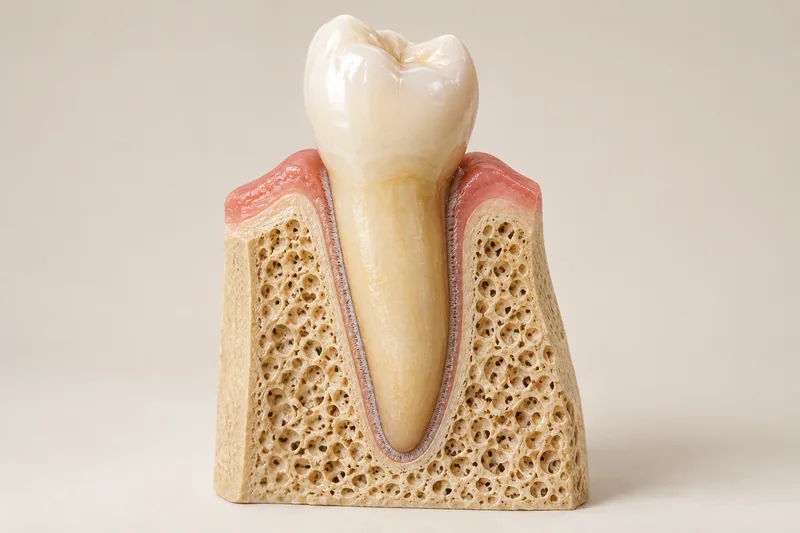
Fine fibres anchor teeth in bone. Load capacity also depends on the remaining support.
Mobility and discomfort have several causes. Contacts and periodontal support need joint assessment.
Mechanical overload differs from biofilm-associated periodontitis. Bite adjustment cannot replace indicated periodontal care.
Tooth-supporting tissues.
No.
Have the cause assessed.
Three steps. No audio.
Each scene can also be selected manually.

Silent educational film with German on-screen text and simplified teaching images. Not a patient case or a promised treatment outcome. The full English explanation is available below.
Fine fibres anchor teeth in bone. Load capacity also depends on the remaining support.
Mobility and discomfort have several causes. Contacts and periodontal support need joint assessment.
Mechanical overload differs from biofilm-associated periodontitis. Bite adjustment cannot replace indicated periodontal care.
Occlusion describes contacts; trauma describes tissue damage.
No. A contact finding and tissue injury are different.
No. Excessive forces and inflammatory disease are distinct issues.
Not automatically. Its cause, support and restorability need assessment.
Editorially suggested question to discuss with Dr Niusha Barahmand Pour:
What might explain this mobility or tenderness on biting?
New mobility or pain on biting deserves assessment.
Discuss tooth supportAppointment selection at DoctolibOcclusion describes contacts; trauma describes tissue damage.
Editorial research: . General information, not an individual diagnosis or treatment recommendation. Teaching illustrations are simplified and do not depict a patient case.