Should I stop the medicine?
Change prescribed treatment only with the prescriber.

An oral lichenoid drug reaction is mucosal inflammation possibly related to a medicine and resembling oral lichen planus. It may cause whitish lacy streaks, red areas or soreness. Appearance alone cannot establish the trigger.
For training & practice ↓
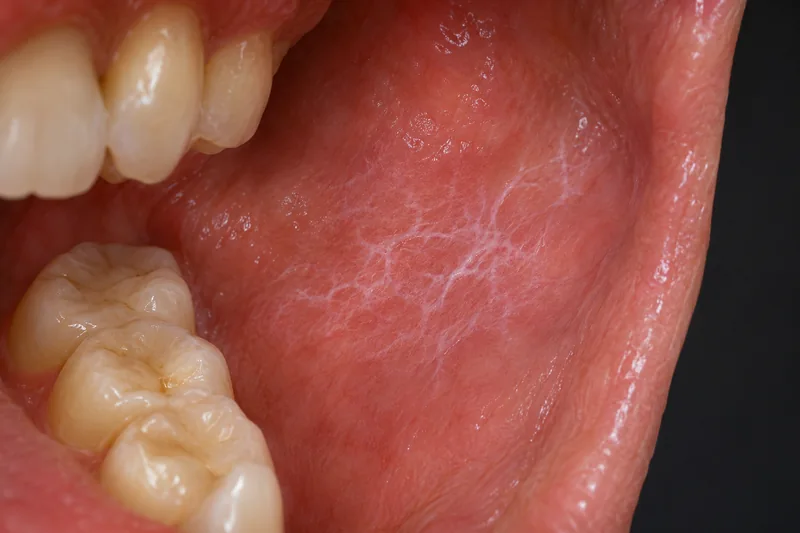
White streaks or red tender patches may occur on the cheek, tongue or gums. Several conditions can look similar.
Changes may appear some time after starting a medicine. Include long-term prescriptions and over-the-counter preparations in the list.
Tissue biopsy can characterise inflammation. The team weighs several clues when assessing a possible link with a particular drug.
Change prescribed treatment only with the prescriber.
A medication-associated lichenoid reaction is not contagious.
After the trigger is removed, changes may take weeks to months to settle.
Three steps. No audio.
Each scene can also be selected manually.

Silent film with English on-screen text and simplified teaching images.
Clinical and microscopic appearances may overlap. The drug history contributes to assessment.
Dental clinician and prescriber weigh benefits, risks and alternatives. An unsupervised trial can put the underlying condition at risk.
Burning occurs in several oral mucosal disorders and needs clinical assessment.
Usually it cannot. Tissue appearance, clinical pattern, medication history and subsequent course are considered together.
Bring your medication list and photographs of the change if available.
What other causes are possible and when should the area be reviewed?
Arrange prompt assessment of a persistent sore or firm area.
Call the practice · 0221 669 401 80Telephone contactA temporal association can raise suspicion but does not prove a drug effect.
Editorial research: . General information, not an individual diagnosis or treatment recommendation. Teaching illustrations are simplified and do not depict a patient case.
If you turn this on, this website stores which guides you open, separately from advertising preferences. The markers expire after a fixed 30-day period from activation. The list is not sent to us by this feature. You can turn it off here and delete the markers.
Other people using the same browser profile can also see the markers. German and English versions share one marker. Expired entries are removed the next time you open a page with this feature; deleting browser data may remove them earlier. “Viewed” means opened, not read or completed.