What tissue is treated?
In oral surgery, primarily mineralised bone.

Piezosurgery is a method of working on bone with a piezoelectrically driven instrument. Its tip makes very small, rapid movements. This can support controlled bone cutting in selected oral surgical procedures. The method is not automatically painless or free from injury risks.
For training & practice ↓
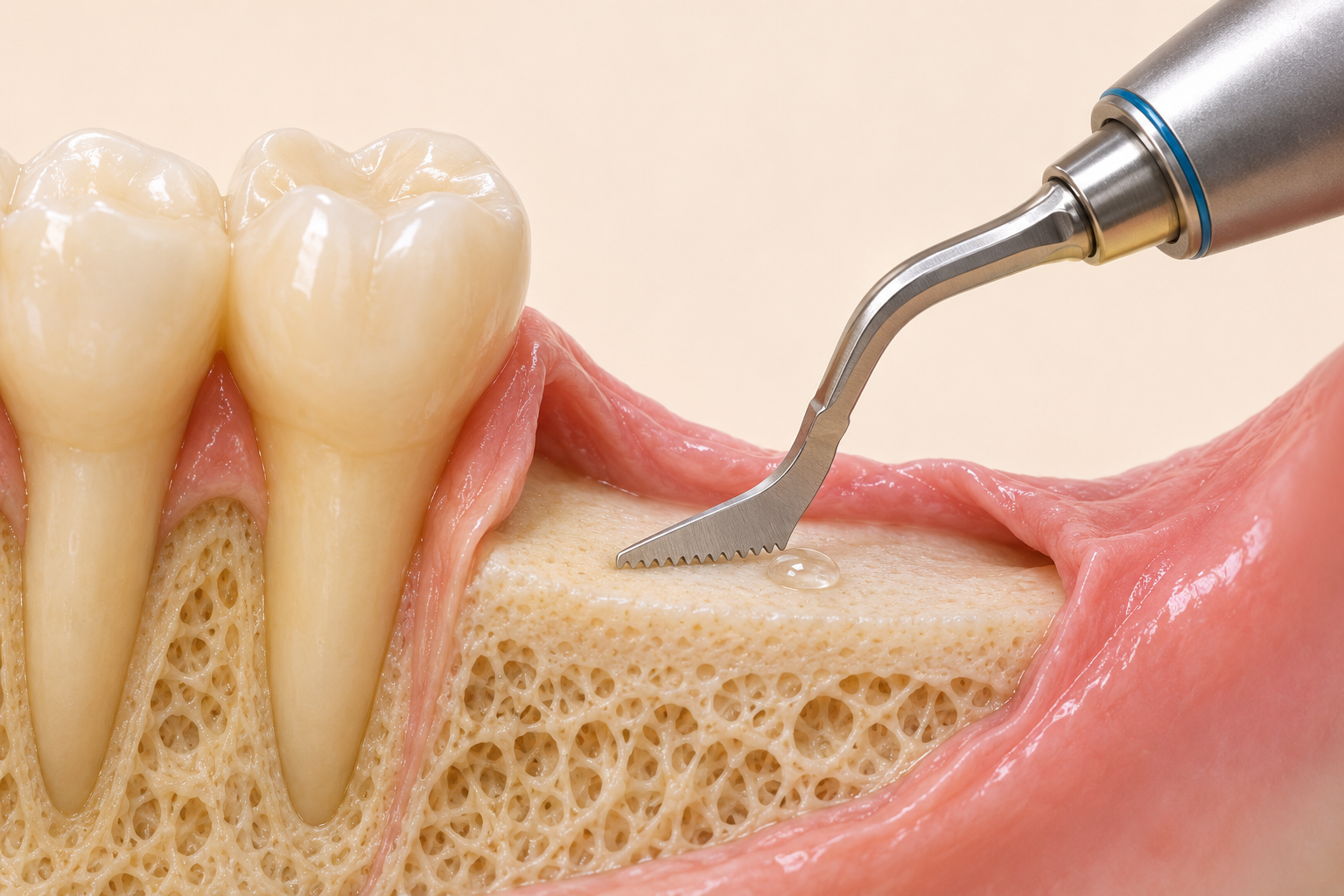
The device converts electrical energy into fine mechanical vibrations. An appropriate tip works on mineralised bone; cooling and correct use are part of the technique.
Whether piezosurgery, rotary instruments or a combination is suitable depends on the surgical aim, access and nearby structures.
Tissues still require protection, excessive heat must be avoided and healing needs monitoring. Small studies of particular procedures cannot guarantee an individual outcome.
In oral surgery, primarily mineralised bone.
No. Planning, cooling and tissue protection are still needed.
The findings, surgical aim, neighbouring anatomy and clinical experience.
Three steps. No audio.
Each scene can also be selected manually.

Silent educational film with German on-screen text and simplified teaching images. Not a patient case or a promised treatment outcome. The full English explanation is available as text.
Both may use vibrations. Piezosurgery works on bone during surgery; scaling devices have different tips and purposes.
No general conclusion is possible. The methods have different properties. A small comparison in alveoloplasty does not establish a ranking for all operations.
No. Injuries are not completely excluded. Proximity to nerves, pressure, duration and instrument control remain important.
No. Equipment, experience and indications vary. Ask which technique is planned for your operation and why.
You can bring this question to your appointment:
What are the advantages and limitations of the planned instrument technique for my procedure?
Before planned surgery, you can ask for an explanation of the procedure and the instruments involved.
Discuss your findingsAppointment selection at DoctolibBoth may use vibrations. Piezosurgery works on bone during surgery; scaling devices have different tips and purposes.
Editorial research: . General information, not an individual diagnosis or treatment recommendation. Teaching illustrations are simplified and do not depict a patient case.