What happens?
Small building blocks form a larger structure.

Polymerisation is a chemical reaction joining small building blocks into larger molecular structures. In many composite fillings, a suitable curing light starts this reaction: the initially mouldable resin matrix hardens.
For training & practice ↓
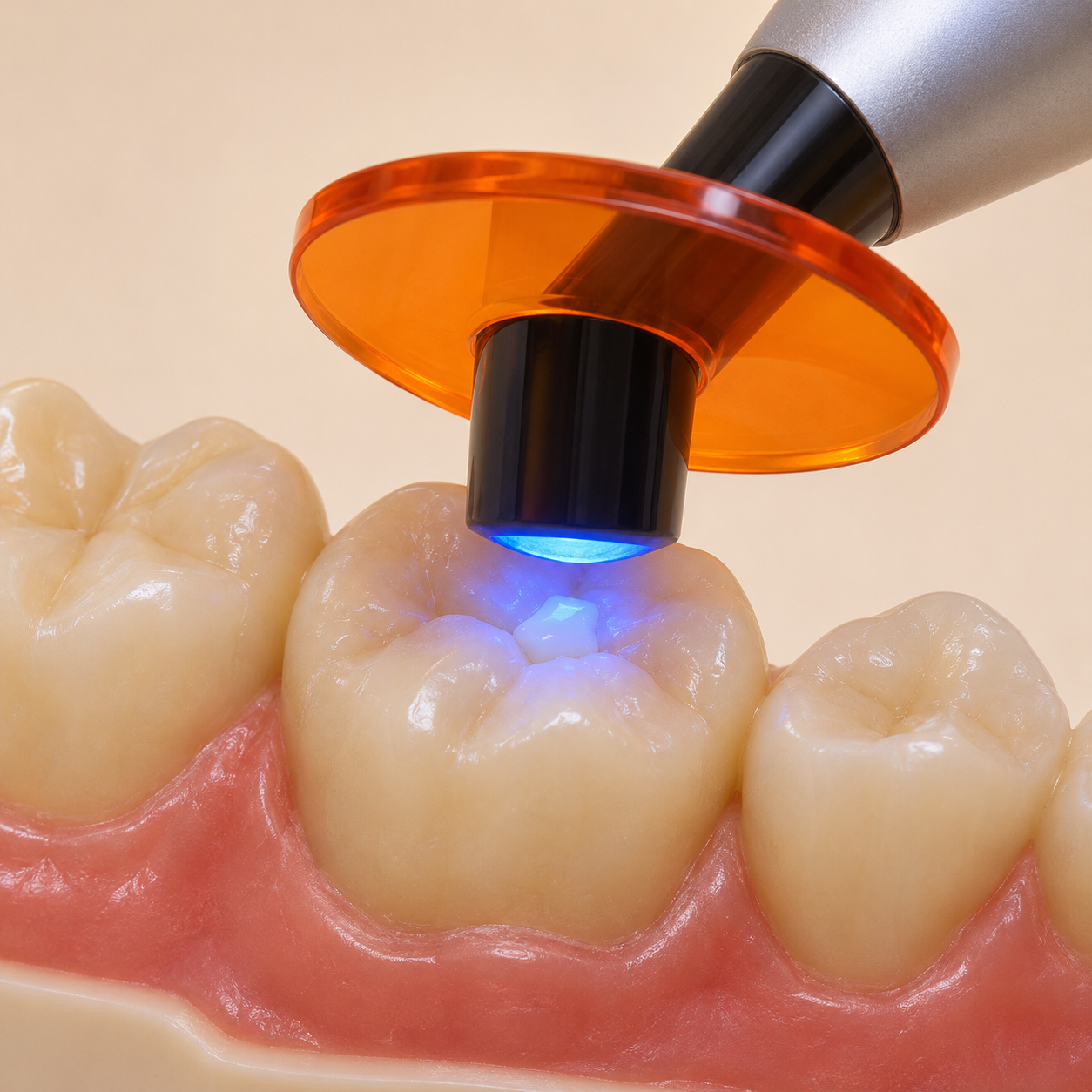
Composite contains a resin matrix and filler particles. The matrix initially allows the tooth shape to be formed; polymerisation describes its chemical linking.
A light-sensitive component absorbs suitable wavelengths and initiates the reaction. A lamp looking blue does not by itself establish adequate curing.
Layer thickness, light reaching the material, distance and exposure time affect the result. The team follows the requirements of the particular material and device.
Small building blocks form a larger structure.
The resin matrix hardens.
No; correct curing belongs to professional treatment.
Three steps. No audio.
Each scene can also be selected manually.

Silent educational film with German on-screen text and simplified teaching images. Not a patient case or a promised treatment outcome. The full English explanation is available as text.
Curing hardens the material. Attaching it to a tooth additionally requires a suitable bonding or cementation process. These are coordinated but different steps.
No. Common curing lights use visible light, not X-rays. Appropriate eye protection is still important.
No. Material, shade, thickness and lamp determine the required technique. There is no universal number of seconds for every filling.
No. It is one important factor. Bonding, shape, loading and care also affect a restoration.
You can bring this question to your appointment:
How is adequate curing ensured for my filling material?
Discuss your individual findings and whether a referral is appropriate.
Discuss your findingsAppointment selection at DoctolibCuring hardens the material. Attaching it to a tooth additionally requires a suitable bonding or cementation process. These are coordinated but different steps.
Editorial research: . General information, not an individual diagnosis or treatment recommendation. Teaching illustrations are simplified and do not depict a patient case.