When?
Immediately after insertion.

Primary stability is the mechanical hold immediately after implant insertion. With successful healing, biological bonding with bone contributes later. A firm initial fit alone does not prove successful integration.
For training & practice ↓
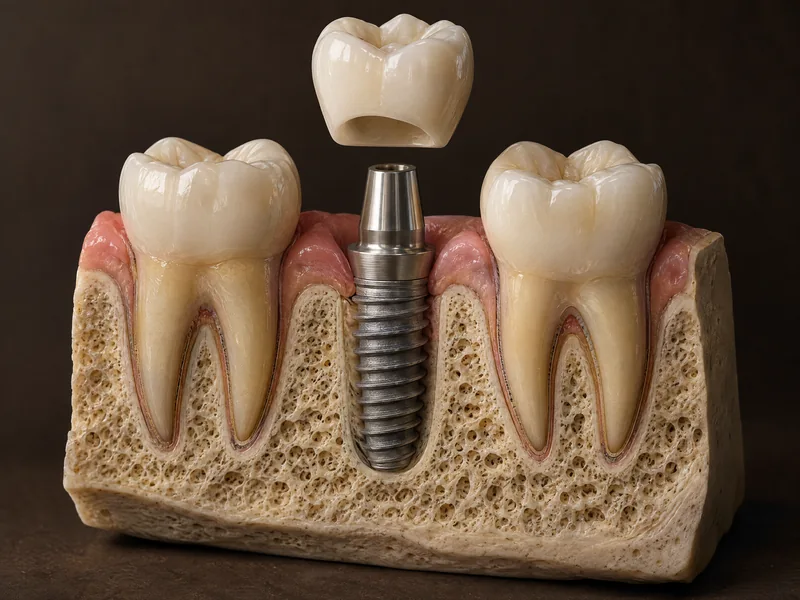
Bone characteristics, implant design and site preparation influence mechanical stability.
The bone–implant connection develops with successful healing. Initial hold and biological stability are different aspects.
Loading decisions use several findings. One measurement is not a universal approval for immediate loading.
Immediately after insertion.
Develops with successful healing.
According to an individual plan.
Three steps. No audio.
Each scene can also be selected manually.

Silent educational film with German on-screen text and simplified teaching images. Not a patient case or a promised treatment outcome. The full English explanation is available as text.
Primary means initial mechanical hold; secondary reflects biological anchorage developing during healing.
No. Maximising a number is not a general treatment goal; clinical context matters.
No. Primary stability means mechanical hold; osseointegration is the biological connection.
Do not wobble or self-test the implant. Stability assessment belongs to the treating team.
Editorially suggested question to discuss with Dr Niusha Barahmand Pour:
Which findings determine when my implant can be loaded?
The timing of restoration and loading should be explained clearly.
Discuss the implant timelineAppointment selection at DoctolibPrimary means initial mechanical hold; secondary reflects biological anchorage developing during healing.
Editorial research: . General information, not an individual diagnosis or treatment recommendation. Teaching illustrations are simplified and do not depict a patient case.