What is its purpose?
Retaining a removable partial denture on suitable remaining teeth.

A denture clasp is a retaining component of a removable partial denture. Its flexible part engages a suitable tooth undercut and resists displacement away from the tissues. Supporting and stabilising elements also form part of the design.
For training & practice ↓
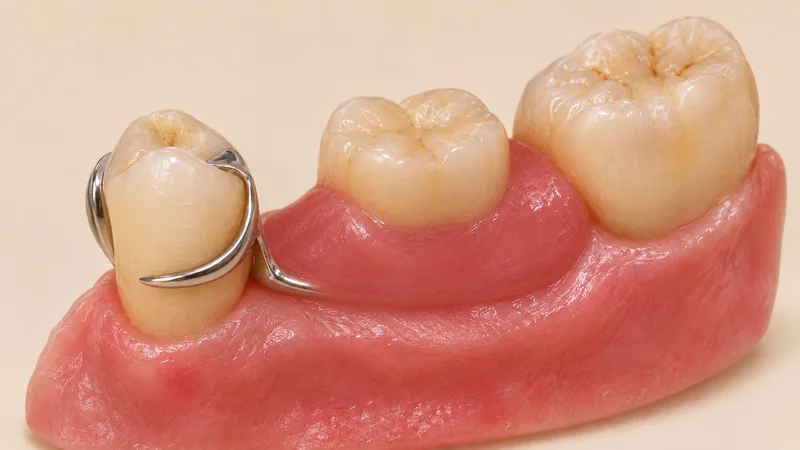
The clasp embraces part of a tooth. Its retentive arm uses a suitable area below the greatest tooth contour. Not every visible metal component has the same function.
Rests and other clasp components provide support and stability. Design depends on teeth, spaces and bite; simply bending a clasp tighter is not an appropriate solution.
Supporting teeth and clasp areas need careful cleaning. Looseness, breakage or pressure calls for assessment. Do not bend the clasp yourself.
Retaining a removable partial denture on suitable remaining teeth.
Clean denture and supporting teeth and have fit checked.
Do not bend it yourself; have the cause assessed.
Three steps. No audio.
Each scene can also be selected manually.

Silent educational film with German on-screen text and simplified teaching images. Not a patient case or a promised treatment outcome. The full English explanation is available as text.
A clasp embraces the tooth externally. A precision attachment uses interlocking components and is a different retention mechanism.
No. Planning, fit, loading and hygiene matter. Supporting teeth require follow-up; an ill-fitting or poorly cleaned construction can cause problems.
That depends on material, damage and denture design. Examination determines whether repair or modification is possible.
The clasp, supporting tooth or denture-bearing tissues may have changed. The cause should be identified before adjustment.
You can bring this question to your appointment:
Do the clasps, supporting teeth and rests of my partial denture still work together properly?
An examination can clarify the finding and any need for referral.
Arrange an assessmentAppointment selection at DoctolibA clasp embraces the tooth externally. A precision attachment uses interlocking components and is a different retention mechanism.
Editorial research: . General information, not an individual diagnosis or treatment recommendation. Teaching illustrations are simplified and do not depict a patient case.