Where is it?
On the palatal side of the upper jaw.

A quad helix is usually a fixed wire appliance in the upper jaw. Four small loops provide springiness. Once adjusted by the orthodontic team, it can widen a narrow upper dental arch.
For training & practice ↓
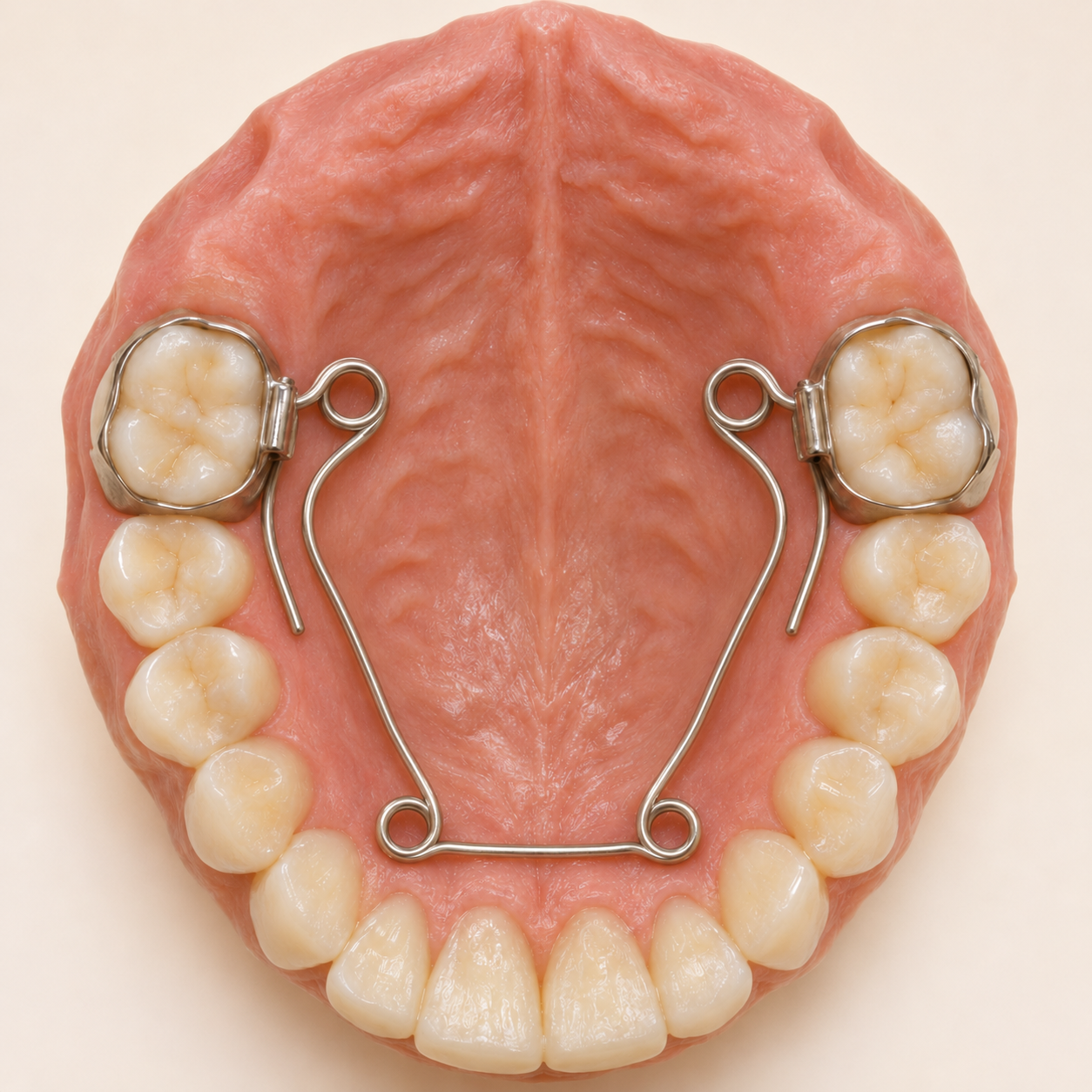
The wire lies on the palatal side and is usually attached to molars with bands. Its four loops give the appliance its name.
Activation applies forces to teeth and their supporting structures. The aim and achievable width depend on age, bite and initial dimensions; not every narrow jaw needs this device.
The orthodontic team adjusts and reviews the appliance. Do not bend it yourself. A loose band or troublesome wire should be checked by the treating practice.
On the palatal side of the upper jaw.
Individually planned dental-arch expansion.
No.
Three steps. No audio.
Each scene can also be selected manually.

Silent educational film with German on-screen text and simplified teaching images. Not a patient case or a promised treatment outcome. The full English explanation is available as text.
A quad helix is a spring-wire appliance for slow expansion of the upper dental arch. Rapid palatal expansion usually uses a different appliance design. Tooth movement and changes in supporting tissues depend on the method and the individual findings.
A typical quad helix uses a springy wire with four loops. It is different from the usual screw appliance for rapid palatal expansion.
No. Adjustment is performed by the treating team.
No. Tooth tipping and changes in supporting tissues depend on the appliance, findings and growth. The device name alone does not describe the outcome.
You can bring this question to your appointment:
What kind of expansion is intended for my particular findings?
Discuss your individual findings and whether a referral is appropriate.
Discuss your findingsAppointment selection at DoctolibA quad helix is a spring-wire appliance for slow expansion of the upper dental arch. Rapid palatal expansion usually uses a different appliance design. Tooth movement and changes in supporting tissues depend on the method and the individual findings.
Editorial research: . General information, not an individual diagnosis or treatment recommendation. Teaching illustrations are simplified and do not depict a patient case.