Where?
Across the palate between upper molars.

A transpalatal arch connects the right and left upper molars with a wire across the palate. It can support tooth positions or be adjusted to move molars deliberately. Its role depends on the treatment plan.
For training & practice ↓
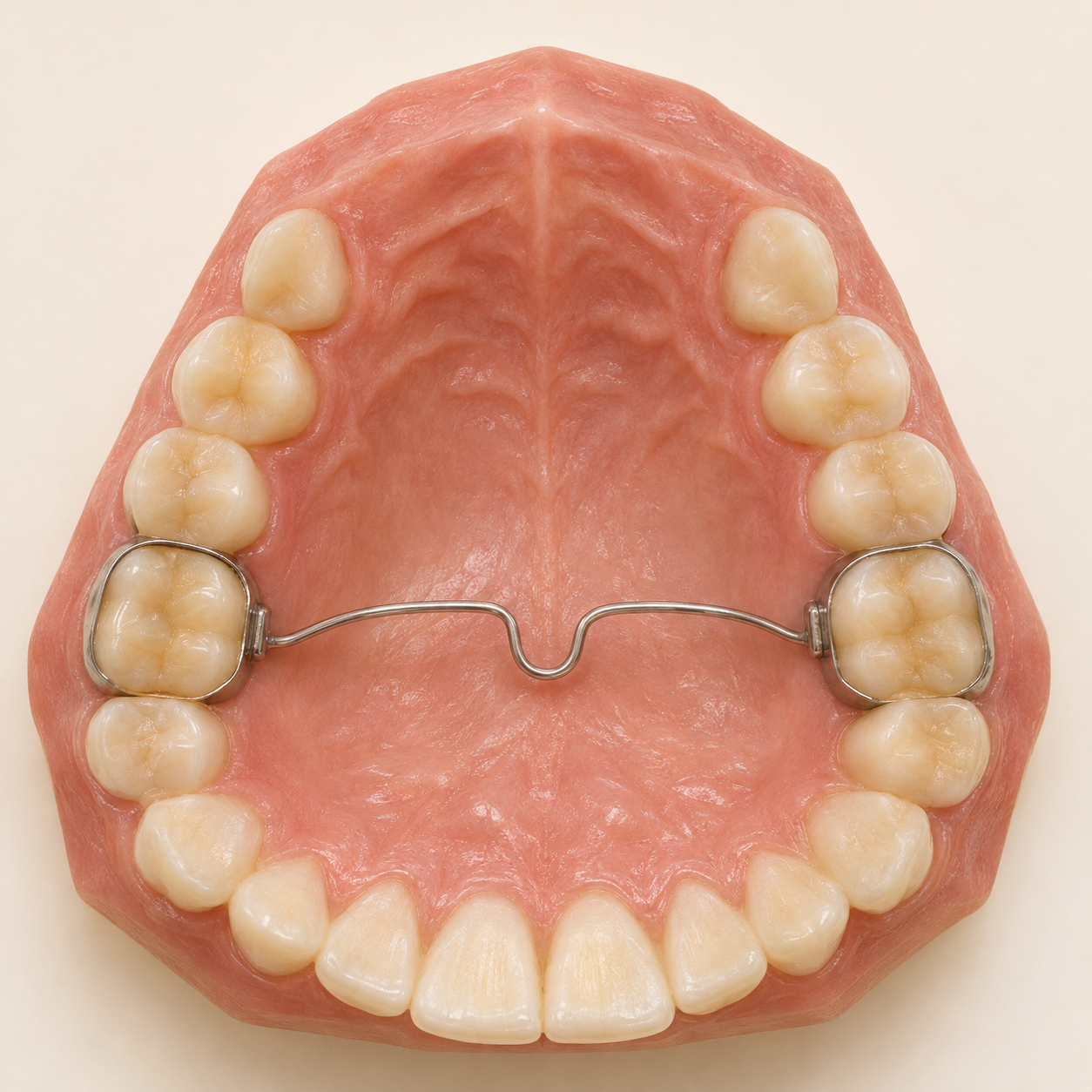
The arch passes between upper molars with clearance from the mucosa. It often has a central loop and attaches to molar bands.
A passive arch supports position; an activated arch delivers planned forces. Similar-looking wires may therefore serve different purposes.
Connected molars can still move under load. A TPA is not absolute anchorage. Additional measures may be needed for a particular task.
Across the palate between upper molars.
No.
No.
Three steps. No audio.
Each scene can also be selected manually.

Silent educational film with German on-screen text and simplified teaching images. Not a patient case or a promised treatment outcome. The full English explanation is available as text.
Both lie near the palate. A quad helix has four spring loops and is used for expansion; a TPA has a different construction and can also be passive.
Not in the usual sense of a front-tooth retainer. A TPA connects upper molars and may be used during active treatment.
No. It may remain passive or be activated. Its appearance alone does not reliably establish the intended effect.
No. A TPA alone may be insufficient when anchorage demands are high.
You can bring this question to your appointment:
Is my palatal arch intended to hold or move teeth, and how will this be checked?
Discuss your individual findings and whether a referral is appropriate.
Discuss your findingsAppointment selection at DoctolibBoth lie near the palate. A quad helix has four spring loops and is used for expansion; a TPA has a different construction and can also be passive.
Editorial research: . General information, not an individual diagnosis or treatment recommendation. Teaching illustrations are simplified and do not depict a patient case.